A positive resolution of this issue depends on individual people getting involved and taking action. Even if you don't live in Cayuga Heights, you can make a difference:
1. Speak up
Contact the following decision makers and let them know your questions and concerns:
Cayuga Heights Trustees:
Chris Crooker email
Stephen Hamilton email
Diana Riesman email
Richard Robinson email
Peter Salton email
Phone messages for the trustees can be left at (607) 257-1238.
2. Sign our online petition Visit Change.org for a quick and easy way to get your name added to our petition and have an email sent in your name to the decisionmakers.
4. Sign up to receive updates Sign up at the top of this column.
5. Help educate others Get your friends, neighbors and colleagues involved in the public dialogue about this important issue. Begin by letting them know about this web resource. You can do that quickly and easily by clicking on the Send-to-a-Friend button.
6. Attend meetings of the Cayuga Heights Village Trustees
The Village Trustees are the decision makers. Consider attending these public meetings and letting the trustees know your questions and concerns.
Village Trustee meetings are open to the public and are held at 7 PM on the second Monday of every month.
PETITION: Tell Cornell to Stop Trapping Deer and Shooting Metal Rods Into Their Brains Read and sign the petition here
4/3/14 UPDATE - The Ithacan offers in-depth coverage of Cornell's trap & bolt deer-killing controversy.
3/28/14 UPDATE - Syracuse and Binghamton TV News stations cover our breaking story and petition.
CNY Central's Jim Kenyon reports that this is not the first year Cornell has been trapping and bolting deer without public knowledge.
WBNG-TV's Kelly McCarthy reports on the thousands who have signed CayugaDeer.org's petition to stop Cornell's trapping and bolting of deer.
Cornell Deer "Management"
This is what happens to animals killed by Cornell under the DEC's "nuisance permit" Sign our Petition
3/21/14
BREAKING: Cornell is using barbaric trap & bolt method to kill Ithaca deer
It is with a heavy heart that we share some news that is certain to be upsetting to many people in the Ithaca community and beyond.
We recently obtained access to a letter dated March 4th, sent by Cornell's Office of Community Relations to a handful of local public officials. The information contained in this letter revealed that faculty and staff members of Cornell’s Department of Natural Resources (DNR) are in the process of turning our community into a slaughterhouse for deer.
We have further learned from more than one source that, in addition to brutally killing individual after individual with arrows, Cornell's DNR staff are capturing deer in traps and killing them with captive bolt guns.
This is all happening in areas much closer to home than we could ever have imagined.
Why is Cornell Turning Our Community into an Open-Air Slaughterhouse?
CayugaDeer.org has long maintained that the wildlife division of NY State's Department of Environmental Conservation (DEC) seeks to use the Ithaca community as a gateway to “net and bolt” killing of suburban deer -- a technique widely condemned by veterinary experts and humane societies for its egregious cruelty. Faculty and staff of Cornell’s DNR, whose actions often serve to further the DEC’s cynical agenda while cloaking it in a veil of perceived academic legitimacy, have been setting up “Clover traps” (collapsible box traps) on Cornell-owned property in various areas of the Town of Ithaca. They are then killing the deer they capture by ramming a metal rod into their skulls using a “captive bolt” device similar to those used in slaughterhouses.
In Defense of Animals, a national animal protection organization, writes: "The trap-and-bolt method of 'wildlife management' is so cruel that only a handful of U.S. cities have tried it, some of them being forced to stop after activists exposed the shocking reality of how much suffering it causes."
The university is trapping and bolting deer under a wildlife "nuisance" permit it obtained from the DEC, which allows Cornell to kill 40 deer during the month of March. Along with bowhunting -- which studies have shown leaves up to half of its victims wounded and running off to endure an agonizingly slow and painful death -- the nuisance permit allows non-conventional techniques which are controversial even within the hunting community. In addition to trapping and bolting, permissible practices include baiting, the use of spotlights, and killing deer well into the nighttime hours. All this activity is currently legal and may be happening at any of the following locations within the Town of Ithaca, up until Cornell's current nuisance permit expires on March 31st:
• In and around the Robert T. Jones Golf Course
• East of Caldwell Road and South of Forest Home Drive
• North of Plantations Road and East of Judd Falls
• Between Pine Tree and Game Farm Roads
• South of Mitchell Street and East of the East Hill Recreation Trail
• South of Rt. 13 and West and East of Sapsucker Woods Road
Why is the DEC Imposing its Trap & Kill Agenda on NY State Communities?
Ithaca is not the only community being targeted by the DEC’s improper use of nuisance permits. Long Island residents recently obtained a Temporary Restraining Order from a NY State Supreme Court judge barring the DEC from issuing more nuisance permits until their case is heard at the end of the month. One of the petitioners complained in the media about the "sweeping, archaic policies" of the DEC, which, despite widespread public opposition, is now trying to condemn entire populations of deer as “a nuisance” in order to open the door to mass-killing campaigns in New York's suburban neighborhoods.
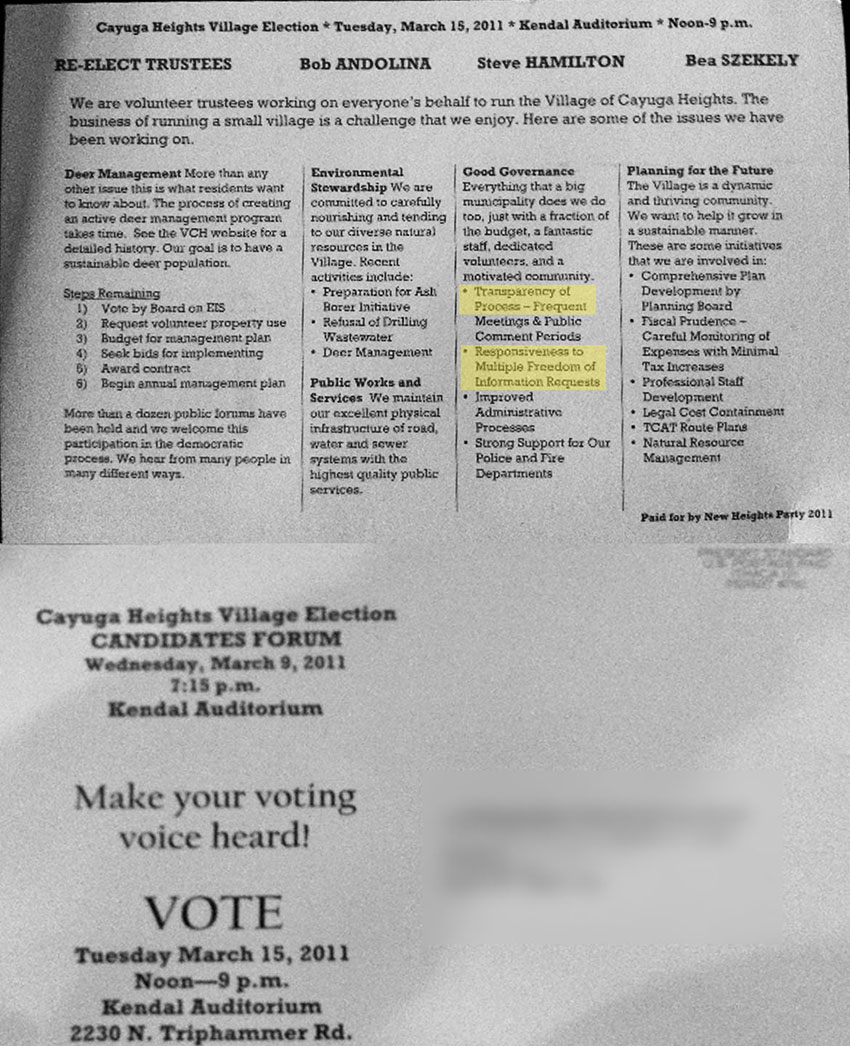
When Cayuga Heights Mayor Kate Supron attempted to bring net and bolt killing into our community, the result was an outpouring of public revulsion followed by years of bitter acrimony between neighbors that continues today. Cornell's DNR faculty and staff, including Bernd Blossey, Paul Curtis and Jay Boulanger, have each been actively working to encourage the mass-killing of deer in Tompkins County. It has been reported by area residents that Blossey and Boulanger have even been going door to door trying to talk people into allowing deer to be killed on their properties. All three of these Cornell-affiliated individuals have been involved both in public and behind-the-scenes campaigns aimed at convincing area municipalities that non-lethal approaches to addressing deer-human conflicts are inadequate. The message they have propagated is that the mass-killing of deer is necessary to avert an ecological and public health crisis. Such contentions have been roundly rejected by numerous national-level scientists, as we have thoroughly documented on our web site and in several news stories over the years.
Along with influencing public policy and convincing individual residents to allow killing activities on their property, these Cornell staff members are also personally killing numerous deer themselves as part of various “management” programs. Despite knowing very well how trapping and bolting deer violates the values of our community, they, along with higher-ups at Cornell, have chosen to carry it out in locations all around us, simply bypassing a transparent public process.
The vast majority of people in our community have no idea of the Cornell-sponsored animal cruelty and killing that is taking place in locations that they drive, walk, or jog past every day. And if they did, there would be an uproar, which is exactly why an attempt has been made to get all the killing done before most people are even aware it is happening.
Will Our Community Tolerate the Whitewashing of Animal Torture and Killing?
On its deer management website, Cornell gives the impression that those running the program are receptive to feedback from the community and in favor of public dialogue on deer management issues. Yet, the people in charge of this program are engaged in acts of violence that they know most people will find morally reprehensible, and they do it out of public view.
This photo is from Cranbrook, British Columbia, where a similar trap and bolt program has been carried out. After a captured deer has endured the frigid temperatures overnight, the killers arrive, the box trap is collapsed on top of the helpless and terrified animal, and a captive bolt gun is used to shoot a metal rod into her brain. Over the last couple weeks, a timeframe in which we know this kind of activity has been taking place here in Ithaca, the temperatures have plunged into the single digits on several occasions. This means captured deer could have spent hours exposed to the freezing cold, unable to seek the warmth of shelter before being slaughtered.
Once a deer is caught in the trap she often thrashes about wildly in a panic, which only gets more desperate when her killers show up and forcibly wrestle her to the ground. Even in highly controlled circumstances bolt guns are a grisly way to kill an individual, however with a wild animal who is fiercely struggling for her life, there are so many ways the bolt can veer off its intended placement, instead going through an eye or a shoulder and taking multiple shots before having its intended impact. You can see what the trapping process looks like and hear the desperate cries of captured deer in these two videos, here and here, which are from research programs at other locations that did not involve killing the deer.
Ohio resident Nan Richardson visited a trap and bolt site in the Cleveland area. She spoke of her firsthand experience at a public meeting, saying:
The licensed nuisance control person was very hesitant in allowing me to see what he did. He warned me that this could be emotionally traumatic and said he always took great efforts to keep this far from the public’s view… I mentally tried to prepare myself for what I might see. As I soon discovered, nothing could have prepared me.
Once we arrived at our destination, a private residence in a suburb of Cleveland, I saw a beautiful doe caught in the clover trap. Deer are wild animals and are not accustomed to human contact, so as we approached her it became obvious that her being trapped was causing significant distress.
She jumped up and began to cry. She sounded exactly like a human baby. I’ll never forget that sound. She was frantic. Her natural instinct was to flee. She could not, which only compounded her extreme fright and misery. She then began to throw herself against the cage violently. She banged her head against the cage again and again in attempts to escape, all the while screaming.
I will never ever forget what I saw next. She flipped over backwards and fell to the ground. It looked as if her eyes had exploded in her head. She had a fatal heart attack. She was literally scared to death. The licensed expert told me this does happen sometimes even before he can finish the job with the captive bolt. I had seen enough and was glad I was spared viewing anymore horror and cruelty.
The experienced, licensed expert then dragged the poor doe to his truck as if he were hauling trash to the curb. At this point I was sick to my stomach and raging at all who were responsible for this cruelty and torment. They use all kinds of excuses to substantiate torturing wildlife and the overseers and officials, such as municipal governments and Division of Wildlife Officers, use sanitized words to disguise the truth and fool the public into believing that this repulsive cruelty is humane and quick.
All I know is this doe was crying out for her life, for mercy, and I could do nothing. She suffered a horrific death despite having escaped the barbaric steel spike driven through her skull.
The letter from Cornell to public officials specifically mentioned that the 40 individuals who were to be killed under the DEC's nuisance permit would be "anterless" deer. At this time of year, many does are pregnant, with fawning season taking place between May and June. So the violence is only amplified when nearly mature fawns suffocate and die in the wombs of their slaughtered mothers.
That these abhorrent acts are being performed just out of sight under a facade of academic legitimacy makes the situation all the more disturbing. For many long-term residents, this is a troubling reminder of how the prestige and power of Cornell can be used as a cover to carry out actions that are so clearly harmful to the local community. In this case, the DEC’s political agenda -- which includes attempts to block NY State municipalities from taking a “no-kill” approach to addressing deer-human conflicts -- is being served without the community being adequately informed, much less given the opportunity to consent.
Many of us choose to live in Ithaca because we believe in this community’s potential to be a beacon of hope, a place dedicated to creative and peaceful conflict resolution with a long, proud history of cultivating alternatives to violence. Right now, our best traditions are being disrespected and degraded by the actions of a few influential players at Cornell and the DEC who are pursuing hidden agendas at the expense of the wider community.
What You Can Do
Sign our petition to Cornell and the DEC and share it widely. Every signature automatically sends an email to officials in a position to stop this insanity and helps prove to them the public does not accept what they are doing.
1/29/14
BREAKING: Bowhunting 151 feet from your home?
We learned some shocking news today that has implications not only for the situation in Cayuga Heights, but for all of New York State.
Gov. Cuomo is now advocating the 500 foot rule be reduced to 150 feet for bowhunting. That would mean hunters would only need permission if they were discharging crossbows, compound bows and longbows within 150 feet of an occupied dwelling in New York State — bringing deadly weapons and the violent killing of wildlife more than three times closer to our homes than the current law allows.
Mayor Kate Supron's Latest Deception - Bait and Switch
For two months now, Mayor Supron has maintained that her new proposed law allowing bowhunting in Cayuga Heights would be greatly restricted by the 500 foot rule. At both the December and January public hearings, she said it would be nearly impossible to find an 18 acre piece of land where all the neighbors agreed to allow weapons to be discharged (18 acres refers to the area covering a 500 foot radius around any given bait/kill site).
One person then asked her why she was even proposing this law. Her response was that it would allow motivated landowners to try to convince their neighbors to participate, and maybe they would have better luck than she did identifying viable kill sites. Trustee Stephen Hamilton added that the only place he could see where they had any chance of finding that 18 acre area of agreement might be the Southeast corner of the Village that borders Cornell, known as Palmer Woods (more on that below).
Not once during this time when people were bringing their safety concerns about the bowhunting law before Mayor Supron did she or her fellow trustees disclose that the 500 foot rule might soon be changed to 150 feet. None of them can deny knowing this fact. It has been part of the DEC's recommendations for a state-wide deer management program since October of 2011. And when we were amongst just a handful of attendees at a Village meeting last summer, Mayor Supron explicitly expressed to her fellow trustees that she was hopeful this change in the 500 foot rule might be occurring soon, opening up new possibilities for killing deer in Cayuga Heights.
The Devil is in the Details
If you look at the way Cayuga Heights' proposed new law is written, it is carefully constructed to allow bow hunting as long as participants "comply with the discharge requirements of New York State Environmental Conservation Law Section 11-0931."
That was where the 500 foot rule was supposed to come in. But if that rule is changed to 150 feet as the DEC is hoping for and Gov. Cuomo is now advocating, there will be nothing a resident can do to stop deer-killing from happening 151 feet away from their home (NOT their property line, but their house itself). Imagine how close 150 feet is and how this change in law would not only expose one's family to potentially lethal dangers but also to being witness to ugly and brutal violence toward animals.
The Time to Get Involved is NOW
For those of you who have been sitting on the fence, what happens in Cayuga Heights Wednesday night is crucial and will have implications beyond the Village. There is still time to participate in a state-wide effort to stop the DEC's push to bring hunting closer to all New Yorkers' homes. But for now, we have an immediate need to stop this law from being passed in Cayuga Heights. It has been confirmed that Cornell has already been scouting Palmer Woods for a bait and kill site.
Discharging Deadly Weapons in an Area Teeming with Human Activity?
Ground Zero for Cayuga Heights' expected commencement of deer killing appears by all accounts to be Palmer Woods. This patch of land between Triphammer and Pleasant Grove Roads, just beyond the A Lot as you are heading away from Cornell, is a very active area. There is a day care center on the edge of the woods. There is a frisbee golf course in Palmer Woods. People walk their dogs in that area, and pedestrians cut through it on their way to campus. There is a parking lot with hundreds of cars on the edge of it, housing for hundreds if not thousands of students nearby, and it is bounded on two sides by two roads that are very well-traveled at all times of the day by people going into and out of Cornell's campus.
If this law passes, deer killing can go on during any season, and at any time of day, even at night — potentially within 150 feet of people's homes, against their wishes. How can anyone in good conscience expose so many people, their families, and their companion animals to these kinds of dangers?
Another Important Question
Isn't the responsibility of the police, first and foremost, to protect the safety of our community's residents? Isn't that more important than protecting plants from deer who might eat them? Why are the heads of police giving a pass to Mayor Supron and her colleagues in Cornell's Department of Natural Resources, who are equal partners in her obsessive quest to kill deer?
WHAT YOU CAN DO
Contact the Cornell and Cayuga Heights police departments to let them know you are concerned about how public safety will be compromised by this dangerous new law:
Cayuga Heights Police Chief James Steinmetz can be reached at 257-1011 and by email. Cornell Police Chief Kathy Zoner can be reached at 255-8945 and by email.
Please carbon copy your letters to Cornell University's President, David J. Skorton. Email address here.
12/5/13
ALERT: Keep crossbows and deer hunters out of Cayuga Heights
UPDATE - The text of the law was slightly revised at the December and January meetings of the Board of Trustees, so there is a new public hearing scheduled for Wednesday, January 29 at 7 PM. You can read the current version of the law here.
PUBLIC HEARING - Wednesday, Jan. 29th, at 7 PM, Marcham Hall, 836 Hanshaw Rd, Ithaca Map
Mayor Kate Supron is so obsessed with killing deer that she is now introducing a new law that will open Cayuga Heights' densely populated neighborhoods to bowhunting and the use of deadly crossbows.
If passed, this lawwill allow residents to carry out killing activities themselves, or to invite bowhunters or paid contractors into their yards to kill deer. The DEC will enable this by issuing residents a wildlife "nuisance permit", which gives permission for deer killing to take place outside of hunting season as well as the use of techniques that aren’t allowed during hunting seasons such as baiting deer. We expect this law to be voted on after the public hearing on Wednesday, and if it passes, it is likely to go into effect right away.
Bowhunters will still be legally required to obtain permission from residents before discharging deadly weapons within 500 feet of their homes. However, there is a clause in the proposed new law that allows those who have only wounded but not killed deer to pursue and kill the animals on properties where no permission has specifically been granted, provided they make a "good faith effort" to obtain the permission first. Just imagine the potential dangers this will create -- as well as the heightened resentment, distrust and acrimony among neighbors.
How will residents know when someone in their neighborhood is going to be stalking deer with a long bow or crossbow? How will they know whether or not strangers seen carrying out these activities are authorized by a resident to do so? Who will enforce the 500 foot rule and ensure that those discharging deadly weapons have the requisite permissions from neighbors?
Bowhunters in Cayuga Heights will inevitably end up chasing after d eer they have wounded, and will almost certainly end up on properties where the owners did not allow permission for hunters to set foot on their land.
How practical will it be to obtain permission from a property owner when the goal is to kill a terrified, wounded animal who is fleeing through yard after yard? Once that deer is wounded and on the run, those who are discovered chasing and killing her without consent from landowners will be able to claim they had no time to obtain permission, and that “they had to do what they had to do” for reasons of “mercy” or public safety.
Bow hunting is notoriously cruel. Numerous studies show that more than half the deer who are shot with arrows are never retrieved, running off to painfully bleed to death or live with a debilitating open wound. In Lansing, the owners of SunDowns Farm at first opened up their property to bow hunting but then removed permission because of the cruelty they say it was causing to the animals. Do we really want to potentially expose our community's children to the trauma of witnessing this violence, when a deer shows up wounded, dying, or dead in the family yard?
Deer who are wounded and pursued by bow hunters are also more likely to cause car accidents. Statistics from car insurance companies show that on the first day of hunting season, deer-car collisions spike by as much as 300-400%, likely caused by deer being startled or wounded from hunting activities, or being driven off their normal routes of travel by hunters in pursuit. Matriarch deer teach the yearlings and fawns how to safely cross roads. When hunters kill the matriarchs, it creates the potential for new traffic hazards due to confused and disoriented deer.
Deadly weapons are dangerous to everyone in the vicinity. Every hunting season, news stories come out about cats, dogs, and other animals wounded and killed by arrows that hunters had presumably intended for deer. It's hard to overestimate the potential hazards that this new law will introduce to our community. The photos below give just a few examples of how things can go terribly wrong. We apologize for their graphic nature, but feel they are important to help people more fully understand what is at risk here.
Permitting bow hunting in a densely populated village like Cayuga Heights, and putting public safety decisions into the hands of individual property owners, is simply reckless. It is also an invitation to violate the rights of residents who do not wish to have deer killed anywhere near their homes, nor to be exposed to horrible violence against animals.
What possible justification can Mayor Supron have for putting our community at risk in this way? Having just spent more than $150,000 of tax payer money to sterilize 95% of the does in Cayuga Heights (costing more than $1,000 per sterilized deer), she is now opening the door to killing these sterilized deer, who are only likely to be replaced by fertile deer moving in from surrounding areas. The Village's own deer management consultant has publicly stated that with the percentage of sterilized does Cayuga Heights now has, the deer population will go down within a few years. It's been reported in the media that many residents are already seeing fewer impacts from deer browsing in their yards. The vast majority of residents did not give permission for deer to be killed on their land or near their homes. By all accounts, the divisive battle over the deer in Cayuga Heights should be over. So why the urgent push to kill again? Why now?
It's up to concerned citizens to speak out against the reckless endangerment of our community, before it's too late!
What you can do
Attend and speak out at the public hearing on the new law that will open Cayuga Heights to the use of crossbows and other deadly weapons wielded by residents, their acquaintances, and/or people they hire. Wednesday, January 29th, at 7 PM, Marcham Hall, 836 Hanshaw Rd, Ithaca Map
If you can't attend the meeting, write or call the Cayuga Heights Board of Trustees to let them know your concerns. There are two new board members as of April, 2013, who have not yet heard from the public on these matters, Rich Robinson and Peter Salton. Their contact information, and that of the other trustees, can be found here.
10/23/13
ALERT: Deer-killing advocates expand their crusade county-wide
TIME-SENSITIVE: Please read and share our "Open Letter to the Residents of Tompkins County." This week's events, featuring many of the same players behind the push to kill deer in Cayuga Heights, mark the beginning of a concerted attempt to expand their mass-slaughter mentality to the rest of Tompkins County. Closed-door meetings with legislators, one-sided panels designed to manipulate public perception, even the scientifically debunked lyme disease argument is getting dusted off to scare people into going along. We are at risk of having a county-wide repeat of the disaster in Cayuga Heights, and we all need to become more informed and involved to prevent our community from going down this wasteful, irrational, and dangerous path. Learn more
9/14/13
ALERT: Deer at risk as Mayor Supron pursues killing again
Last winter, for the fourth year in a row, the Cayuga Heights government's plan to kill most the deer in the Village did not succeed. This time, instead of being held up by an environmental review process or a legal injunction, the plan was stopped cold because Mayor Kate Supron was unable to persuade enough residents to allow deer to be shot and killed near their homes. So in November of 2012, she and the Village trustees agreed to pay Anthony DeNicola of White Buffalo, who had been slated to do the killing, $150,000 to sterilize the deer instead of baiting and shooting them.
According to the Village's own reports, 95% of the does are now sterilized. By any reasonable standard, this should have been the end of the controversy.
The Ugly Reality of Bait and Shoot Killing, performed by White Buffalo, the same contractor that Cayuga Heights is now working with. If enough residents agree to allow the killing of deer near their homes, we can expect this kind of grisly scene to play out in Village backyards. (Undercover footage by SHARK)
But Mayor Supron and her fellow trustees won’t let go of killing. Another winter is coming, and they have once again sent out permission forms to residents, hoping that this year they will be able to pull off a mass-shooting operation in the midst of Cayuga Heights' densely settled neighborhoods.
The questions we posed five years ago, when this controversy began, are just as relevant today. Is it rational? Is it ethical? Is it safe?
The residents of Cayuga Heights have been through a bitter five-year controversy that has turned neighbor against neighbor and alienated the larger Ithaca community from Cayuga Heights. Now, even with their "problem" well on its way to being solved, Mayor Supron and the trustees inexplicably won’t let the controversy die. They are indifferent to the damage they cause each time they fan the flames of conflict.
And to accomplish their grisly, reckless, and irrational goal, they are willing to deceive their own constituents.
Over the past year, Mayor Supron and her colleagues have misled their constituents and the media into believing that a small minority of landowners in the Village had blocked their backyard shooting program from moving forward. Despite numerous Freedom of Information Law requests, the mayor refused to release the statistics from resident permission forms upon which her false claims were based.
With all other options exhausted, CayugaDeer.org co-founder Jenny Stein brought a lawsuit to obtain this crucial information, with her case being represented by attorney Trevor DeSane. NYS Supreme Court Judge Robert Mulvey ruled that Stein had substantially prevailed in the case and that the Village did not have a reasonable basis for denying access to the records she had requested. He ordered that her attorneys fees be paid by the Village and that Mayor Supron finally release the landowner consent forms she had been illegally withholding.
With the data now in hand, this is the secret that Mayor Kate Supron wasted thousands of taxpayer dollars trying to cover up:
The owners of 75% of properties in the village — not 10%, as Mayor Supron repeatedly claimed — withheld permission for the Village government to shoot deer on their land or near their homes.
You can find CayugaDeer.org's full investigative report, including video and and court documents here.
Trying to convince the majority that they are in the minority is a shameful betrayal of public trust. Just as bad, the mayor and her colleagues have refused to come clean with the public even though their deception has been uncovered. In the letter Mayor Supron just sent to Village property owners, she again implied that the only problem with pulling off the killing last year was that the property owners who refused permission just happened to be distributed in such a way to make the killing plan unworkable. In doing this, Kate Supron and the trustees who approved her letter are demonstrating their utter contempt for the intelligence of this community. Ironically, with this letter, they have again wasted taxpayers' money to fulfill an agenda that is politically-motivated, and not in the best interest of their constituents.
And why shouldn't ruthless people continue to abuse their power if they are not held accountable? The fact is, at the time Mayor Supron's letter was hitting mailboxes earlier in the week, Cayuga Heights residents were still largely unaware of the her attempted deception. As recently as last June, the Ithaca Journal was still reporting the mayor's deceptive figures. Without having access to the truth — that owners of 75% of the properties withheld permission for deer to be shot near their homes last year — Village residents were vulnerable to being manipulated yet again.
We decided it was time to set the record straight. On Friday, two days after Cayuga Heights residents received Mayor Supron's solicitation letter in the mail, the entire Village received a mailing from CayugaDeer.org that revealed the truth behind the mayor's deception, informing those who did not want to have guns going off in their neighborhoods or deer being slaughtered on the lawns next door that they were in the majority, not a tiny minority as they had been led to believe.
You can see the Village's mailing here and CayugaDeer.org's mailer, which arrived just two days later, here.
For five years we have worked together to prevent the unfolding of a horrible tragedy in Cayuga Heights that has the potential to become a model for backyard mass killing of suburban deer in New York Sate and beyond. We have come a long way, but as these recent events demonstrate, our work is not over yet.
YOUR HELP IS NEEDED to bring the truth to light. Please hold Cayuga Heights officials accountable by sharing this newly released information about their deceptions with as many people as possible. You can also help by contributing to the Deer Legal Fund, which pays for legal initiatives to stop the killing and enforce New York State’s Open Meetings and Freedom of Information Laws, which have been violated several times by the Cayuga Heights government. To date, legal interventions have played a major role in averting the killing and bringing the truth to light. Thank you all for your kind support! It is what makes these interventions possible. Please make checks payable to the Deer Legal Fund and send them ℅ CayugaDeer.org, PO Box 373, Ithaca, NY 14851.
6/21/13
Village Attorney Reinforced Mayor Supron's 10% Deception
Today, we updated our investigative report with new video footage that shows how Village Attorney Randy Marcus played a central role in reinforcing Mayor Supron’s deceptive message that the deer-killing program was blocked by the owners of just 10% of the properties in Cayuga Heights. Several reports that appeared in the media the day after this video footage was taken demonstrate how the false impression was given by Village officials that most Cayuga Heights residents had approved the killing of deer on their land, when in fact 75% had not.
"The Village Board of Trustees sent out surveys to the owners of 900 parcels in the Village seeking permission to hunt deer on their property, and while a majority said yeas [sic] 90 property owners said no. The board says even though its only 10% of land in the village firearm restrictions make it impossible for the culling strategy to be successful."
And now, more than six months later, the 10% Deception continues to be propagated. Just last week, the Ithaca Journal reported:
"Supron said the village is considering asking landowners again for their permission to shoot deer. About 90 landowners denied the village permission to kill deer on their property during fall 2012.”
The reality, withheld by Mayor Supron from the public, was that the Cayuga Heights government was unable to obtain permission to kill deer from the owners of 701 of the 933 Village properties — that's 75%, not 10%.
"Perhaps Mayor Supron thinks that if enough Cayuga Heights residents are convinced they are part of a small minority who do not want a backyard deer-killing program, they can be pressured into granting permission to have deer killed on their land and guns fired near their homes," says CayugaDeer.org spokesperson James LaVeck.
It is hard to blame members of the media for reporting Mayor Supron’s deceptions as fact, especially when misleading information was so emphatically repeated by Village officials, including the Village attorney. But now that the truth has come to light, shouldn’t the officials involved in this deception come clean and correct the false impression they gave the public? Shouldn't they be scrapping any future plans for a backyard deer-killing program in a community that so clearly doesn't want it?
And if they can't do that, if they still can't put the public good before their private agendas, shouldn't they do the right thing and resign?
BREAKING: Cayuga Heights mayor's deception PROVEN by court-released documents
New evidence obtained through a court order proves, once and for all, that Mayor Kate Supron and the Cayuga Heights government has been deliberately misleading the public and flouting the law.
A new investigative report and accompanying video published by CayugaDeer.org shows how this newly uncovered information goes well beyond the deer issue itself, into questions of honesty and integrity in local government, and just how far some officials are willing to go to fulfill their personal political agenda at the expense of the community.
Last November, the Cayuga Heights trustees abandoned their deer-killing program, due to insufficient support from property owners to provide shooting sites. Instead, they decided to pursue a mass-sterilization program that was carried out over two weeks in December. A May, 2013 study found that an estimated 93% of the does in Cayuga Heights had been sterilized. Yet, Mayor Supron, against all reason, is announcing in the press that she is still considering pursuing a deer-killing program this Fall.
In the meantime, through a recent court order, CayugaDeer has been able to obtain access to records that contain important data that Mayor Supron was desperately trying to keep secret from the public, to the point of flouting NY's Freedom of Information Law, and then, when legally forced to comply, defying a court order by producing incomplete and irregular documents that suggested the possibility of tampering.
When the data was all in, what it showed was that 75% of property owners in Cayuga Heights did not give permission for deer to be killed on their land — not 10%, as she and other Village officials had led the public and the media to believe when they announced their change of plans last November.
For years, Mayor Supron has claimed she had a mandate to pursue her backyard deer-killing program, but now the evidence is in. There is no mandate to kill deer when there is so little cooperation from residents.
If anyone wonders how it is that all the scientific evidence refuting the justification for a killing program was ignored, if they wonder how it could be that the officials in Cayuga Heights were so indifferent to the damage they were doing to the fabric of our community, needlessly turning neighbor against neighbor, look no further. Here is your answer.
For nearly five years now, CayugaDeer.org has fastidiously documented and exposed deception after deception from the Cayuga Heights Board of Trustees, and we have done our best to bring this information to those in a position to rein in a government that has gone rogue. Yet, accountability for public officials engaged in conflicts of interest, deception and other egregious behaviors is increasingly scarce these days, as we found in the case of Cayuga Heights. When abuse of power goes unchecked, people grow bitter with each other and disempowered within themselves, often not realizing why.
It's time to take our power back. But that requires each of us to become more informed and involved, and to make sure that the people of our community are aware of what's going on right under our noses. So we ask you to take the time to absorb the new information documented in our report. At the end of the day, the people of Cayuga Heights will have to decide if they want Kate Supron to continue to run their government's business. But her decisions affect all of us in Ithaca, so It is crucial that we educate ourselves and as many people as possible about how the Supron administration has deceived the public, and why.
Second Generation Remember the orphaned fawn who was being raised by a buck? The buck in this photo is that fawn, grown up, who took on his own orphaned fawn to care for. The photographer named the buck Tony Jr., after his dad.
We have some amazing news to share! At a public meeting earlier this week, the Cayuga Heights government announced that they are suspending their plan to perform a mass slaughter of deer in Village! This unexpected turn of events comes only weeks before the killing was planned to begin. So the deer have been spared the barbarism -- and our community spared the trauma -- that has threatened to destroy our peaceful way of life for the last four years. But how did this come about?
As many of you know, a judicial injunction is what blocked the killing from taking place last winter, based on a legal challenge that included a scientific critique from national-level experts at Harvard, Tufts, Yale, and the Cary Institute of Ecosystem Studies. These leaders in their fields roundly rejected the rationale for the killing plan, characterizing it as “misleading,” “deeply flawed,” “commits a serious oversight,” and having “insufficient evidence,” and “no site-specific data.” Furthermore, in the public comments that were collected during the official State-required comment period, there was overwhelming community opposition to the program, and comparatively little support.
Despite all this, the injunction was rescinded this past June by a NY state Appellate court. This disappointing ruling removed the last legal protection remaining for the deer, and Cayuga Heights Mayor Kate Supron announced in the media that the killing would begin in December.
For years now, Mayor Supron has insisted that Cayuga Heights residents are overwhelmingly in favor of her plan, and would support the mass shooting of animals in neighborhood yards, adjacent to countless homes, roadways, walking trails, and other highly populated areas. Thankfully, she turned out to be wrong. In the end, she and her fellow trustees were simply unable to convince, pressure, or cajole enough land owners to allow firearms to be discharged within 500 feet of their homes, a permission that is required under New York state law. As a result, they were left with insufficient sites to lure in and kill the deer.
We all owe a debt of gratitude to the village residents who resisted the pressure, disinformation and scare tactics, banding together to stop this tragedy from unfolding. Many thanks are also due to all the individuals who participated in a multi-year effort to educate the community and stand against a plan that, from the get-go, was so clearly unscientific, unethical, and unsafe. In the end, our work together enabled reason, compassion, and common sense to prevail!
But our work is not over, not quite yet. While Mayor Supron has conceded that the killing cannot proceed, she qualifies her statement by adding, “for now.” The trustees’ new plan is to spend up to $180,000 to sterilize 145 deer over a period of two weeks, using the same contractor — White Buffalo — that was originally slated to kill the deer. You may recall White Buffalo’s founder and president, Anthony DeNicola, was reported in the media to have compared the mass slaughter of deer to brushing his teeth and mowing the lawn. Likewise, Prof. Paul Curtis of Cornell University, who conceived of the idea of capturing, tagging and sterilizing a core population of “survivor” deer and then exterminating all their herdmates around them year after year, is slated to receive $30,000 as the first installment of what is expected to be a multi-year consulting contract.
Mayor Supron and her colleagues have publicly expressed an interest in reviving the killing plan if new laws can be passed that will enable the discharge of firearms closer than 500 feet to homes. In a meeting last week, the heinously cruel net & bolt option was also discussed by the trustees.
In short, while the killing has once again been blocked, we unfortunately cannot tell you that this battle is over for good. Incredibly, there is no indication that Mayor Supron or her fellow trustees have taken any of the extraordinary events of the last fours years as an indication that backyard mass slaughter is a bad idea.
We will not rest until the kill program is permanently rescinded, and a long-term, non-violent alternative is implemented in Cayuga Heights, enabling deer and humans to peacefully co-exist. In the coming days we will be providing more details of how we can all ensure that we make further progress toward that goal.
For now, let’s take this moment to appreciate what has been accomplished, knowing that our work together has once again averted an impending tragedy, and against the steepest odds. We are so very grateful to each person who supported this long, and often thankless-seeming effort. Together, we have made a real difference, not just for the people and animals of this community, but for all of those fighting wildlife killing campaigns in other communities around the globe.
3/5/12
FOIL documents expose mindset of Cayuga Heights deer-killing contractor
On Jan. 9, 2012, the Cayuga Heights government passed a new law which will allow White Buffalo (employee pictured above) to discharge deadly weapons in Village neighborhoods, paving the way for the mass-shooting of deer in residents' backyards.
As part of a recent Freedom of Information (FOIL) request, CayugaDeer.org obtained a letter sent by deer-killing contractor Anthony DeNicola of White Buffalo Inc. to Cayuga Heights Mayor Kate Supron. This correspondence offers a rare glimpse into the mindset of the man the Village trustees have chosen to implement their "deer management” program. In it, Mr. DeNicola expresses his outrage at the injunction imposed by the Appellate Division of New York's Supreme Court, which puts the killing on hold until a legal appeal is heard and decided upon. He characterizes this ruling, a unanimous decision made by five Appellate Court justices, as "insane."
The passages below comprise the entirety of Mr. DeNicola’s January 8th email to Mayor Supron, which was also cc'd to officials at the DEC.As you read his words, bear in mind that this is the person the Supron administration has chosen to discharge weapons in family neighborhoods, and in whose hands the safety and well being of our community’s residents is going to be placed.
Anthony DeNicola begins his letter:
“Kate, I woke up this morning thinking about how insane this ruling is. Deer have been increasing in numbers for decades and becoming a problem in many developed areas for nearly as many years. State wildlife agencies have been liberalizing actions to address this situation (under their professional discretion and authority) and have been the responsible party for wildlife management since the inception of the discipline. Hundreds of thousands of deer are killed in NY, and millions are killed across the country, each year during hunting season, yet the NY Supreme Courtwants to hear a case about managing a few hundred deer? The only different [sic] is that in developed areas special methods are often necessary so a permit must be issued to manage deer outside of traditional recreational hunting methods/regulations/seasons. The result of hunting or alternative management is the same, deer are killed.
Notice Mr. DeNicola's lack of attention to the substance of the legal challenge, for example, the potential negative impacts this program could have on the safety and quality of life of residents in our community. Also completely disregarded is the impact on the deer – the family groups that will be shattered by the killing, the fawns who will be orphaned, and the wounded animals who might escape death on the first couple of bullets, only to experience more horrors before their painful deaths. What appears to be lost on Mr. DeNicola is that, although many deer are indeed hunted and killed elsewhere, they have never before been baited and slaughtered in Cayuga Heights, and to our knowledge, have never before been shot en mass in neighborhood yards anywhere else in NY State.
Mr. DeNicola continues: Not only has the Village gone much beyond what should be required (DEC review and permit issuance) by conducting a SEQR review, now the Supreme Court wants to review a judge's ruling that the process was adequately followed. If this does not sound off alarm bells to the authorities responsible for deer management then nothing will. The cost and logistics of managing deer in developed areas is obstacle enough for communities. To have to prove the need for action beyond the DEC's expert authority will prevent anyone from moving forward; just what the animal rights organizations want. Unless some very concerted effort is put together at all levels, attempting to organized [sic] a deer management program in developed areas in NY will become so legally difficult it will almost never happen.
Here, Mr. DeNicola, a resident of Connecticut, expresses incredulity at our state’s Appellate Court justices involving themselves in this matter, when in reality it is part of their job to ensure compliance with New York State’s environmental law, and to safeguard its intended purpose. SEQRA (NY’s State Environmental Quality Review Act) specifically provides regulations to ensure that government entities, including both municipalities and the DEC itself, adequately consider potentially significant negative environmental impacts of a proposed action, and seriously evaluate lower-impact alternatives. In fact, the lawsuit that resulted in the injunction that is temporarily preventing the killing program from moving forward focused largely on the failure of the Cayuga Heights government to fulfill these commonsense requirements of our state's environmental law.
Mr. DeNicola continues: In respect to the Village's situation, it is very unlikely that any action will be taken this winter season so a new plan should be considered. After many years of painstakingly organizing a plan you now have to wait another year. So now there will be more deer that will have to be killed to meet the Village objectives. I would revise your SEQR analysis and recommend trap and euthaniasia [sic] and sharpshooting first. Then in areas where access is limited you can focus on sterilization, with additional sterilization efforts depending on the relative success of the lethal initiative. I would remove any requirement to sterilize deer first and ensure that trap and euthanasia is an approved method given the housing density in the community and the overly restrictive 500' firearm discharge law.
Let’s step back for a moment and carefully examine what is happening here. In the context of discharging deadly weapons in the densely settled neighborhood setting of Cayuga Heights – weapons that are capable of propelling a bullet as far as two miles – the individual who will be entrusted with pulling the trigger over and over again believes that NY State’s "500 foot rule," which forbids discharge of a firearm within 500 feet of a person's home without their permission, is "overly restrictive". Just how close to a person's home does Mr. DeNicola believe he should be allowed to be while discharging a weapon without their permission? 300 feet? 100 feet? In media reports, Mr. DeNicola has compared the mass killing of deer to "brushing my teeth" or “mowing the lawn.” Could this activity have become so mundane to him that he has lost touch with how safe the average person would feel having guns discharged in close proximity to their residence? Is this a person that we want to empower -- as the recent passage of Local Law J has -- to carry and discharge deadly weapons at undisclosed locations and times in Cayuga Heights?
The Reality of Net and Bolt
An explosive charge propels nets over a group of deer, tossing them in the air and ensnaring them. They thrash around, crying out in fear and panic as they are shot in the head with metal bolts. (Undercover footage by SHARK)
And, to top it all, Mr. DeNicola recommends that Net & Bolt killing be pursued yet again, despite a court ruling last September that took this brutal mass-slaughter technique off the table. Net & Bolt, which Mr. DeNicola euphemistically refers to as "trap and euthanize”, involves using drop nets or rocket-propelled nets to ensnare groups of deer who are sometimes thrown violently in the air, and who cry out and struggle in a state of terror as they and their herd mates are methodically shot in the head with a captive bolt device which fires a metal rod into their skulls. Net & Bolt is widely condemned by veterinarians and humane societies for its egregious cruelty. Even White Buffalo’s web site, when describing this method, concedes that "deer are subjected to great amounts of stress during the restraint component." Yet, Mr. DeNicola is now encouraging the Village Board to reintroduce Net & Bolt as a preferred killing technique. And sadly, Mayor Supron appears to be taking his advice, in defiance of the community uproar that occurred when this barbaric practice was first considered. Observe how she slips this language into a February letter mailed to Village residents shortly after she received Mr. DeNicola’s advice, paving the way for an effort to overcome the judge’s ruling: “The current Department of Environmental Conservation (DEC) permit is for sterilization and culling by bait and shoot. Should these prove to be ineffective in reducing the deer population, an option is to expand the permit to allow netting and bolting.” [Emphasis added]
If Mayor Supron insists on taking our community down this path, Cayuga Heights will very likely become infamous as the gateway for introducing this heinous practice to New York State. To date, no NY municipality has ever used Net & Bolt mass slaughter as part of a deer management program, much less in such close proximity to homes. If Mayor Supron is successful in her pursuit of this practice, the mass-killing of deer could be carried out in one person's yard over the objections of even their next door neighbors. Apparently, this is Kate Supron’s and Anthony DeNicola's "vision" of how to overcome potential problems caused by New York’s "overly restrictive" 500 foot rule, which creates the inconvenience of having to obtain the consent of people who live near potential killing sites.
Mr. DeNicola concludes: As you can see I have CC'd the DEC Wildlife Chief and the Attorney General's office (who has decided not to challenge the ruling for Binghamton University that requires SEQR review to cull deer) so that they fully understand the implications of inaction on their behalf. This is not a "Henny Penny" the sky is falling scenario, this is the start of a seriously problematic trend that animal rights activists will use to stop sensible deer management across your state. The state authorities are foolish to believe that these legal challenges will stop; they will accelerate in frequency. Animal rights activists are very well networked and these "successes" will be spread through their communication loop. In fact, this ruling was commented on by an animal rights person, that I work with on a sterilization effort in Maryland, yesterday during a phone conversation. Word travels fast. Regards, Tony.
Mr. DeNicola’s closing thoughts demonstrate yet again his lack of respect for NY State officials, describing them as "foolish" to not take the actions of animal advocates seriously. The contents of this letter pose a basic question for the people responsible for bringing killing contractors into our community: Can we truly expect those who make their living by rounding up and killing human-habituated animals by the thousands to understand and respect our community and its values? Like those who slaughtered buffalo by the thousands in an earlier era, the life of today's wildlife killing contractors represents a way of being in the world that the overwhelming majority of people find unsettling, if not downright frightening. After all, how many homeowners anywhere think that it is just fine to have people discharging deadly weapons within five hundred feet of their homes without their express permission, as Anthony DeNicola seems to believe we should? How many people feel that baiting and killing fawns and pregnant does is morally acceptable? This is a wake up call, a reality check.
Our community has a proud tradition of standing against injustice, and of being a leader in developing creative alternatives to violence. Paying someone like Anthony DeNIcola to bring death and mayhem into our backyards for the next ten years – as Princeton, NJ, has done with their futile, divisive and never-ending killing program – will be more than a tragedy, it will be a travesty, a violation of everything this community stands for. We must not let this happen.
2/24/12
Mayor Supron to host biased deer-killing forum
On Wednesday, Feb 29 at 7:15 pm, there will be a forum organized by Cayuga Heights Mayor Kate Supron to promote the Village’s deer-killing program to members of our community. It will be held at Kendal, 2230 N. Triphammer Road in Ithaca (map), and is being inaccurately advertised by the Village as offering “neutral people to answer questions the public has.” (Ithaca Journal, 2/13/12)
Mayor Supron’s panel, which she claims is made up of neutral parties, will have the following members:
Cayuga Heights deer committee members deny a bias toward killing that has been clearly documented on several occasions, and even openly admitted to by then-Chair, Kate Supron, who is now Mayor.
• Mayor Supron herself, former Chair of the deer committee that came up with the kill plan in the first place. While still on the deer committee, before becoming mayor, Supron admitted, on camera, that all but one member of this committee were predisposed in favor of killing. The committee refused to seriously consider non-lethal approaches to resolving the conflict with deer, and Supron went on to spend her entire 2-year term as mayor doggedly pursuing her million dollar killing plan, despite overwhelming evidence provided by scientific experts from top institutions that thoroughly refutes the basis and rationale for this program.
• Robert Andolina, Cayuga Heights trustee and outspoken deer-killing advocate who opposed amending the village fencing ordinance out of a publicly stated concern that it would erode support from residents for his preferred deer-killing program.
• Randy Marcus, attorney for Cayuga Heights, who recently made inaccurate and misleading public statements about basic facts concerning the history of the deer-killing program as part of an apparent attempt to dismiss overwhelming concerns being expressed by residents about the dangers of shooting in family neighborhoods.
• Prof. Paul Curtis, the architect of Cayuga Heights’ current deer-killing plan, whose department at Cornell, according to the only cost estimate ever publicly released by the village, is slated to receive an estimated $275,000 for its participation in the program over the next 10 years.
The Reality of Net and Bolt
An explosive charge propels nets over a group of deer, tossing them in the air and ensnaring them. They thrash around, crying out in fear and panic as they are shot in the head with metal bolts. (Undercover footage by SHARK)
• Gordon Batcheller, the DEC’s Chief of the Bureau of Wildlife, who is responsible for introducing the possibility of net & bolt slaughter to the deer-killing plan in Cayuga Heights, a particularly barbaric technique that is condemned by humane societies and veterinary experts, and which is also unprecedented in NY State as part of any deer management program. Before Mr. Batcheller was appointed to his position a little over a year ago, DEC representatives and Paul Curtis told members of the public that net & bolt deer killing is illegal in NY State. The first known reference to using net & bolt in Cayuga Heights appeared in a letter Mr. Batcheller wrote to Mayor Supron less than a month into his new role heading the Wildlife Bureau of the DEC. In this letter, which CayugaDeer.org obtained through a Freedom of Information request, Batcheller offered net & bolt as a technique the DEC would in fact approve. (Note: Last September, a ruling on the lawsuit against the Village took net & bolt off the table as part of the current plan in Cayuga Heights, which is why, for now, the Village is pursuing a bait & shoot program). Mr. Batcheller also said he "strongly advocates" a hunting program in the Village.
• Steve Joule, regional wildlife manager for the DEC who is also actively involved in facilitating Mayor Supron’s deer-killing program and serving the same DEC agenda to introduce the backyard mass-slaughter of deer to New York state communities, whether that killing is carried out by shooting or net & bolt.
So, in the aftermath of overwhelming public outcry about the passage of Local Law J, which allows guns to be discharged in Village neighborhoods by deer-killing contractors, this is the “neutral” panel Mayor Supron assembled to supposedly address people’s safety concerns. Of all the panelists, only one, Chief Steinmetz, has professional qualifications at all pertaining to community firearm safety. Yet, regardless of his qualifications, Chief Steinmetz can in no way function in this situation as an independent safety expert or disinterested party who is free from political obligations to support Mayor Supron’s agenda. Why does the Supron administration stubbornly refuse the common-sense step of allowing the public access to a disinterested, third-party safety expert?
What You Can Do
Wednesday’s forum, while stacked with Mayor Supron’s “yes-men”, provides a rare opportunity to ask questions of the people who have collectively enabled the Supron administration’s divisive and dangerous agenda. There are also people on the panel who are in a position to financially benefit from the deer-killing program, or who have already benefitted from the drawn-out process that has required costly legal advice and hand-holding. While the situation will be tightly controlled – with questions only allowed to be asked in written form and then filtered through an intermediary of Mayor Supron’s choosing – we encourage you to attend, to ask the hard questions that need to be asked, and to bear witness to the quality of answers that are provided.
The last time people had a chance to get answers to direct questions posed to the decision-makers who are driving the deer-killing program was three years ago. That was before it was clear to many people that “reducing the deer population” meant annually bringing gunmen into residential neighborhoods to repeatedly discharge weapons near family homes; before it was known that fawns and pregnant does would be targeted for killing; before it was clear that the only deer that would be allowed to live in Cayuga Heights would be 20 individuals who would be trapped, sterilized, and fitted with ear tags and radio collars, destined to relive the trauma of having their herd mates killed around them year after year; before it was determined by top scientists that the program was doomed to fail and would not address the concerns that it was supposedly designed to solve.
2/13/12
BREAKING: Cayuga Heights dealt another legal blow, deer killing still on hold
In early January, we announced the encouraging news that a preliminary injunction had been granted by the NY State Court of Appeals, temporarily halting Cayuga Heights’ deer-killing program, pending appeal of the lawsuit brought by 12 local residents. Shortly thereafter, counsel for the Village, John Stevens, filed a motion to dismiss the appeal, which if successful, would have put an end to both the injunction and the legal case. Well, we have more encouraging news to share. Last Thursday, five appeals court judges ruled unanimously to deny this motion to dismiss, dealing the Village yet another legal setback!
We can only assume that, with an injunction in place, the trustees nevertheless rushed the vote on Local Law J last month because they were expecting that their motion to dismiss would succeed, thereby paving the way to immediate killing. Local Law J, which allows out-of-town contractors hired by the Village to carry and discharge weapons in family neighborhoods at undisclosed locations and times, met with overwhelming public opposition, including a letter of protest signed by 67 residents and mailed to all residents in the village.
Residents packed into Marcham Hall on Dec. 21 to express overwhelming opposition to allowing contractors to shoot guns at undisclosed locations and times in Village neighborhoods.
Many were shocked when the Village Board took just minutes to unanimously pass the new firearms law, with no public dialogue amongst them, and with no public forum to answer the many questions raised by residents who are deeply concerned about the safety risks inherent in a backyard mass-shooting program. The trustees also recently passed a resolution authorizing a $35,000 initial contract with wildlife killing company White Buffalo, and a $25,000 initial contract with Cornell’s Paul Curtis, who is the architect of the deer killing plan. So clearly, in spite of the public outcry from Village residents over Local Law J, the trustees were still expecting to begin the mass-shooting of deer in neighborhood backyards during these winter months. Yet, once again, their plans have been stopped cold.
For nearly four years now, our community has been plagued by the deeply divisive approach to governing in Cayuga Heights, begun by Mayor Jim Gilmore in 2008, and continued by Mayor Kate Supron since 2010. The tactics these public officials have engaged in to advance their destructive goals have become as controversial as their deer-killing plan itself. At public meetings, frustrated citizens are becoming increasingly more direct in confronting what they consider to be blatant dishonesty and manipulation of the democratic process.
A recent example of the kind of behavior that has alienated so many in this community can be found in a January 9th interview on WHCU radio, in which Mayor Supron made numerous misleading and inaccurate statements that could easily have been refuted by the legal record, if anyone bothered to check. Unfortunately, WHCU only presented the mayor’s point of view, prompting the attorney who represents the 12 local residents challenging the Village to contact WHCU and set the record straight. Here are the misrepresentations made by Mayor Supron about the legal case, followed by attorney Arthur Giacalone’s corrections:
Mayor Supron said, “What it, of course, appears to us is that the judge decided to keep the status quo until an appeal is heard and decided.”
Attorney Giacalone responded, “It was not one judge, but a unanimous panel of 5 Justices that granted the preliminary injunction.”
Mayor Supron said, “The injunction is not based on the merits of the case. Rather, it’s just the judge saying: Okay, we’ll keep things as they are until the appeal is filed, heard, and decided.”
Attorney Giacalone responded, “While the Mayor states that the injunction was not based on the merits of the case, one of the three criteria a court must consider when deciding whether to grant a preliminary injunction is the likelihood of success, that is, whether it appears that the party requesting the preliminary relief will be successful on the appeal.”
Mayor Supron said, “Of course the appeal will have to be an appeal of the decision made by Judge Rumsey in September, in which he stated that all of the plaintiffs’ points were patently without merit.”
Attorney Giacalone responded, “The lower court’s decision never stated, or even implied, that the claims asserted in our lawsuit were ‘patently without merit.’ We are confident that our appeal has substantial merit, and that the appellate court will annul the so-called ‘deer management plan’ adopted by the Village Board.”
Mayor Supron's characterization of the lower court's ruling was also misleading because it did not acknowledge that Judge Rumsey dealt a major setback to the Village by forbidding the use of net and bolt slaughter, which was their preferred method of killing.
Those were just the legal issues. Then there is the talking point that the Village has recently been propagating at meetings, echoed in WHCU’s coverage, that the injunction halted a “13-year deer management program.” The program was in fact only voted on by the Cayuga Heights trustees 9 months before the radio interview, on April 4, 2011.
In this same interview, Kate Supron also claimed there are “active culling programs” in the Village of Lansing and at Cornell. This is simply untrue. There is a difference between hunting and culling, as understood by those in the “deer management” field. Individuals killing deer on private land with the permission of the property owner is known as hunting, whereas a government-funded program that brings in contractors to bait and slaughter deer en masse, including fawns, is known as culling. Lansing and Cornell allow hunting. Mayor Supron plans to pursue culling. While confusing the two terms may serve her public relations goals, it is deceptive and disingenuous, revealing her desperation to make Cayuga Heights’ backyard mass-killing program appear something other than what it is – an extreme and radical departure from our community’s values.
Village Attorney Randy Marcus claims shooting is the only method of killing deer in Cayuga Heights that was ever seriously considered, however media reports, public comment, and the Environmental Impact Statement on which the public's feedback was based prove otherwise.
At last month’s meeting of the Board of Trustees, many in attendance were astonished when Village Attorney Randy Marcus tried to brush off safety concerns about discharging firearms in the Village by claiming that “it’s never been a mystery” that shooting in the Village would take place, that it was “absolutely clear” from the environmental review process that the Village planned to shoot deer, and that shooting was the only method of killing that was ever seriously considered. In fact, there are twice as many references to “net and bolt” killing than to shooting of deer in the document that resulted from that environmental review, and Mayor Supron was quoted many times in the media indicating this was the Village’s preferred method of killing deer.
When public officials fail to practice even the most basic level of integrity, they lose trust. This tragic process has accelerated to the point of no return in Cayuga Heights, and more and more, people are joining the effort to expose these issues and work for change.
1/27/12
Letter: Heights officials don't listen, so vote them out
Written by Elizabeth Root, published in the Ithaca Journal, Jan. 27, 2012 As a regular attendee at meetings of the Cayuga Heights Board of Trustees, I have spoken against their "deer management" plan, which entails annual backyard killings of virtually all the deer that inhabit the village. I feel compelled to comment on the attitude of disrespect shown citizens who oppose this program.
Since the board has gone ahead with specific plans to hire sharpshooters to kill on villagers' property, at times and locations undisclosed to the village at large, there has been a barrage of opposition. Many are convinced that this unprecedented proposal to allow gunfire in family neighborhoods can never be safe, regardless of assurances. Others are opposed on grounds of cruelty and concerns over the emotional impact of the killing on children. Some add that many adults, too, would be deeply negatively affected by this violent alternative to controlling the deer population.
A lawsuit filed by 12 area residents seeking to ban the deer killing is pending. Just days preceding the Jan. 9 board of trustees meeting, five state Supreme Court judges unanimously agreed to place a preliminary injunction that delays the bait-and-shoot plan until the appeal is ruled upon by the New York State Court of Appeals. This is expected to take several months. The lawsuit maintains that the plan to kill off the deer is arbitrary, capricious and irrational. It also claims that the State Environmental Quality Review Act study that preceded the April 4 adoption of the plan disregards the facts and the specific nature of the village, lacks criteria and thresholds for determining the effectiveness of the deer-killing program, and fails to take the state-mandated "hard look" at reasonable alternatives.
At the Jan. 9 meeting, Marcham Hall was packed to overflowing. In the 30 minutes allotted for citizens (mostly Cayuga Heights residents) to speak for two minutes, all but one decried the killing plan. Many speakers spoke to their frustration over not being heard respectfully by the board. As is usual when negative criticism is delivered, however convincing and heartfelt, Mayor Kate Supron maintained a bemused smile and most trustees appeared unaffected, leading speakers to feel they were not being taken seriously.
The treasurer, who sits with the board but usually remains silent, called the audience a "vocal minority." Actually, since there has been no referendum, no one knows who is in the minority.
The trustees proceeded with their backyard-killing plan, despite the judicial injunction and public outcry. They voted unanimously to amend the village firearms law to allow a company of sharpshooters to discharge firearms within the village. Previously, only police were allowed to shoot.
At a recent board of trustees meeting, constituents were led to think their concerns were heard. Surprisingly, the board voted to amend the fencing ordinance to allow yard fences higher than 4 feet. For years, residents advocated for this amendment to protect their gardens from deer grazing (the main reason given for the killing). Many cite fencing as the logical alternative to killing. It came as a nasty shock when, days later, the board announced it was going ahead anyway, as soon as possible, with the killing.
Because of the injunction, a local election will take place in Cayuga Heights before commencement of the killing. Supron and some trustees will be up for re-election. I entreat citizens of Cayuga Heights to seek out potential civil servants to challenge and oppose on the ballot those who appear so unmoved and unresponsive to the voices of their constituent critics.
WHAT YOU CAN DO
Write a letter to the local papers Imporant! Be sure to instruct the editor to contact you for permission before changing anything you wrote for publication
• ITHACA JOURNAL- Send to: Editor, Ithaca Journal, 123 W. State St., Ithaca, NY 14850
or submit by email to: ith-letters@gannett.com
Letters should be 200 words or less and opinion pieces should be no more than 500 words.
• ITHACA TIMES - Send to: Editor, Ithaca Times, 109 N. Cayuga St., Ithaca, NY 14850
or submit by email to: editor@ithacatimes.com
• TOMPKINS WEEKLY - Send to: Editor, Tompkins Weekly, PO Box 6404, Ithaca, NY 14851
or submit by email to: editorial@tompkinsweekly.com
1/19/12
Village attorney publicly misrepresents history of deer-killing plan
Village Attorney Randy Marcus claims shooting is the only method of killing deer in Cayuga Heights that was ever seriously considered, however media reports, public comment, and the Environmental Impact Statement on which the public's feedback was based prove otherwise.
At their January 9th meeting, the trustees of Cayuga Heights took just four minutes to discuss and unanimously approve Local Law J, a controversial measure which will permit out-of-town deer-killing contractors to carry and discharge loaded firearms at undisclosed locations and times throughout the Village. Those in attendance were not only shocked by this, but also by the conduct of the meeting itself. The behavior of the mayor, the trustees, and the Village attorney demonstrated in no uncertain terms why so many people have lost all confidence in the Supron administration. The events listed below were captured on video, and also personally witnessed by numerous members of the media and dozens of concerned citizens who packed Marcham Hall to overflowing, nearly all of whom were there to express their opposition to Local Law J.
1. Board of Trustees walks out on the public Within moments of opening the meeting, Mayor Supron temporarily shuts it down, while she and all the trustees file out of the room to hold a "private session” with the Village attorney. There is no indication of how long they will be absent, or why this must be done before members of the public are allowed to speak. The minutes tick by. Some people decide they cannot wait any longer and leave. 40 minutes elapse. Finally, the trustees emerge. No apology is offered for keeping an entire meeting hall full of people waiting for so long.
2. Citizens are blocked from expressing their concerns Two of the 15 or so people called on to speak during “privilege of the floor” use some of their allotted time to request that the trustees relax their usual 30-minute limit for public comment in order to enable everyone who had come to speak to do so. These individuals point out that the only public hearing on Local Law J was held at 9 am on a weekday right before Christmas, a time when most of the public would find it difficult or impossible to attend, and that the trustees themselves have just made everyone wait 3/4 of an hour to be heard. Regardless, Mayor Supron decides to stick rigidly to the 30-minute time limit and swiftly moves on to the next agenda item, silencing a substantial number of people who had hoped to weigh in on this controversial measure about to be voted into law.
3. Village Attorney makes incorrect and misleading statements about basic facts
Village Attorney Randy Marcus attempts to dismiss concerns that Local Law J is being voted on without adequate public discussion. He insists that “it’s never been a mystery, there’s not been any other alternative that’s been seriously considered up to this point in regard to the killing of the deer, other than by shooting,” and that “it was absolutely clear” in the Village’s Environmental Impact Statement (EIS) “that that was what the EIS was reviewing, the shooting of deer.” What Attorney Marcus fails to acknowledge is that Net & Bolt slaughter -- not the shooting of deer -- is what dominated the public debate during the months that the EIS was being reviewed and commented upon. Indeed, the Net & Bolt slaughter technique was referred to 77 times in the final Environmental Impact Statement, both in comments made by the public and by village representatives — more than TWICE as many times as shooting was mentioned.
While being interviewed at a public hearing about the Village's deer-killing plan, Cayuga Heights Mayor Kate Supron speaks of using the Net & Bolt method of slaughter, indicating that shooting is not the only option under consideration. (Video from WSYR News)
In fact, Attorney Marcus's misleading claim that shooting was the only option “seriously considered” for killing deer in Cayuga Heights is contradicted by several different kinds of documentation. The letter included in the EIS from NY’s Dept. of Environmental Conservation (DEC) specifically lists the net and bolt technique as one of the options available to the Village. And Mayor Supron’s own comments from TV and radio interviews that aired during the time the EIS was being publicly debated indicated that she and her fellow trustees were actively promoting Net & Bolt as an alternative to shooting, due to safety concerns that had been raised by members of the public at hearings -- concerns that, incidentally, she and her fellow trustees have never publicly addressed.
Indeed, the contiguous video record that CayugaDeer.org has created over the last three years in Cayuga Heights shows without question that there has been shockingly little public discussion amongst the mayor and trustees about the detailed policies and procedures, and myriad safety issues, associated with carrying out a backyard shooting program. Numerous commonsense questions detailed in this letter and handout recently sent by concerned residents to their neighbors have NEVER been adequately addressed by the Village administration in print, at public meetings or forums, or in the media. Hence, contrary to Village Attorney Randy Marcus's representations, residents are justified in their concerns about the recklessly inadequate process used to publicly evaluate and approve Local Law J.
4. Local Law J is unanimously approved by Cayuga Heights trustees after four minutes of discussion Despite the public outpouring against Local Law J expressed at both the December 21st public hearing and the January 9th monthly meeting of the Village Board; despite the many reasonable questions raised during these meetings, and also by a group of 67 residents who sent out a mailing to the entire village; and despite many residents’ pleas to keep the community safe for their children and grandchildren, there is no discussion about any safety or ethical issues before the trustees take their vote, no public dialogue or debate amongst them. The new law is unanimously approved in the blink of an eye, leaving some in the room shaking their heads with amazement, others in shock and disappointment. The implication is either that the mayor and trustees have carried out their deliberations on Local Law J behind closed doors, in violation of NY State’s Open Meetings Law, or that they simply do not find this controversial measure, with considerable public safety implications, worthy of substantive discussion before taking a vote. The very few statements offered up by members of the Board prior to the vote only serve to rationalize its passage, not to encourage critical thinking, policy analysis or rational debate.
To get a feeling for how surreal it is that Local Law J, impacting the safety and quality of life of all who live in the Village, would be passed by this group of trustees in just four minutes, consider this video, which documents a discussion amongst this same group of trustees about whether pieces of string strung between poles should be considered "a fence." In this case of "the great string debate," a matter most people would consider too trivial to warrant any discussion at all, the trustees focused their attention on the most minute of details, on and off, over a period of 30 minutes.
To many people, the Supron administration looks more and more like a group of people who have become so obsessed with their deer-killing program that basic principles of democracy and public integrity have fallen by the wayside. The rapidly growing involvement of Cayuga Heights residents in this situation is undeniable proof that more and more people realize that a collective intervention has become necessary. When public officials lose their way, it is the duty of the entire community to participate and help bring about a positive outcome for all involved. Given the possibility that Cayuga Heights' deer-killing plan could become a gateway to similar backyard killing plans being implemented throughout our state, our responsibility to take action is multiplied.
1/8/12
BREAKING: Deer killing blocked by Preliminary Injunction
In a major victory for those opposed to the Cayuga Heights “bait and shoot” deer killing program, Judges of the New York State Supreme Court Appellate Division have unanimously ruled in favor of a motion for Preliminary Injunction pending appeal of the lawsuit brought by 12 Ithaca area residents. This rulingforbids the Village from moving forward with its plan to sterilize 20 deer and kill all the remaining deer in Village backyards until the court issues a final ruling on the appeal, a process that normally takes several months.
This development is a major setback for the Cayuga Heights trustees, who in recent weeks put forth many signals that they intended to proceed with their deer-killing program as soon as possible. On December 12th, they passed a resolution authorizing the signing of a $35,000 contract with White Buffalo, Inc., to perform sterilization and killing. At the same meeting, they introduced Local Law J, which if passed, will allow the discharge of firearms in Village neighborhoods by deer-killing contractors. The trustees also decided in December they would send out a mass mailing seeking residents who are willing to volunteer the use of their properties as killing sites.
Friday’s ruling will be welcome news to the large number of Cayuga Heights residents who came forward at a Dec 21st public hearing to express fervent opposition to allowing guns to be fired near their homes and throughout the rest of the village. Both ethical and safety issues were paramount for the 35 community members who publicly spoke against Local Law J. The response at that hearing was so overwhelming that the trustees decided to postpone their vote on Local Law J until their next meeting on January 9th. There is every indication that on Monday, the trustees will attempt some form of PR damage control and then take steps toward passage of Local Law J and eventual implementation of their killing plan. It's clear that they view the ever-growing public opposition as an obstacle to be "handled" rather than a sign that their plan is fatally flawed.
The time has come for all of us to demand that the trustees face reality and move on. The writing is on the wall. On every front, their plan has been shown to be unscientific, unnecessary, dangerous and hopelessly divisive. What’s needed now is for all of us to bring our community together around an approach that will work for everyone, one that peacefully and constructively resolves the conflicts some village residents are experiencing with deer. There are some people who are experiencing real challenges, and it is entirely possible and practical to create a plan that will help these individuals that will be effective, cost-effective, safe, and non-controversial. There is not now, nor has there ever been, a "need" to wreak havoc in our community in order to address this conflict.
The necessary expertise and the interest in working together toward a better solution are here and available within our community. Over the years, we have watched as a constant stream of local residents came forward to offer their knowledge and expertise about how to maintain a thriving garden while also co-existing peacefully with the deer. We have seen many citizens offer constructive approaches to minimizing collisions with deer, recommending techniques that have resulted in high success rates in other communities. Time and again, the trustees have rejected these helpful ideas in favor of single-mindedly pursuing their bait and shoot plan, which leading wildlife biologists and environmental scientists have shown to be based on flawed premises and an exercise in futility.
It's time to take backyard mass-killing off the table, and start working on an approach more in line with reality. The injunction has given us some time, but unless we use this time to forge a new path together, in a few months we will be back in the same place, facing the imminent threat of backyard shooting. Now is the time we must start working together on truly addressing the needs of both those who are experiencing conflict with deer and those concerned about the lasting damage that will be done by the trustees' dangerous and drastic plan. Your voices are needed to urge the trustees to become a part of this solution, instead of continuing on this reckless path that has become such an acrimonious quagmire for our entire community. It is never too late to change course, to start listening, to start building community instead of ripping it apart.
1/2/12
Outpouring of residents call for safety and sanity in Cayuga Heights
Highlights from public hearing in Cayuga Heights on Local Law J Residents express concerns about allowing contractors to shoot guns in the village at undisclosed locations and times.
On Dec. 21 at 9 AM, the Cayuga Heights trustees held a public hearing on a law that would radically alter the character of the community, allowing contractors to shoot deer within village neighborhoods at undisclosed locations and times. That the only legally required hearing on this controversial measure was scheduled with only a week’s notice to the public, to be held on a weekday morning just four days before Christmas, was viewed by many as a cynical manipulation of the democratic process. In response, 67 Cayuga Heights residents signed and sent a letter to fellow villagers informing them about the upcoming hearing and raising important questions and concerns that have yet to be addressed by the village government.
When the morning of the hearing arrived, despite the fact that many local residents were already out of town or at work or caught up in the pre-holiday rush, Marcham Hall was completely packed, with residents lined up against the walls, filling all the open spaces on the floor, and even taking up a few of the empty chairs at the table with the trustees. Still more residents crowded into the foyer beyond the meeting hall, straining to hear what was going on inside. And then, one by one, 35 people rose up to express their passionate, well-considered statements in support of safety, sanity and compassion, objecting to the reckless endangerment of our community that this shooting program presents. Only nine people spoke in defense of the deer-shooting program, one of whom is a current trustee’s spouse, and two of whom were sitting trustees at the time this plan was originally proposed and developed (2008-09).
Many who spoke against shooting in the village expressed a deep and loving concern for our community's children. School teachers, professors, psychologists, social workers, parents and grandparents communicated in no uncertain terms that they don’t accept the trustees' assertions that the mass killing of deer in unprecedented proximity to family homes is safe, sensible or necessary. Others pointed out that the shooting program would inhibit their activities, making them feel unsafe as they walked their dogs or took jogs in the village, altering the very character of this safe, peaceful community. Some brought up the new fence ordinance that was just passed, and how it had not even been given a chance to help residents resolve their conflicts with the deer before the trustees rushed into the extreme measure of introducing legislation that would allow shooting in village neighborhoods.
By the time the hearing had ended, everyone in the room realized that something amazing was starting to happen. The true character of the Ithaca community, the sensible preference for creative, nonviolent alternatives, the tradition of rational public policy debate and transparent local government, was unmistakably asserting itself. As person after person spoke up for their family’s safety and their community’s well being, a sense of solidarity had begun to emerge. There is now no doubt that the people of Cayuga Heights and Ithaca as a whole are going to stand together on this issue, that we are going to work together as we have for generations to find a better, more creative solution that will strengthen, and not rip apart our community, that will open hearts and minds, instead of shutting them down. We're living in a time when our public institutions are failing us left and right, and more of us are realizing that we need to get involved. While no one there may have thought of it this way, on Wednesday, December 21st at 9 am, the people of Cayuga Heights, supported by a few fellow Ithacans from other municipalities, "occupied" Marcham Hall.
In the aftermath of the public hearing, the trustees went through the motions of a state-required environmental review of the proposed law, disingenuously declaring that the most controversial measure they have ever proposed would have "no significant environmental impact." But instead of holding a vote then and there to pass the law, as they had clearly planned to do, they postponed the vote until their January 9th board meeting. So, another moral victory has been won. The mass-slaughter of deer in Cayuga Heights has been held at bay a little longer. And now, we must build on this amazing momentum and finish the job of stopping the shooting program once and for all.
The voice of reason and the power of true community are rising, an auspicious harbinger of the New Year.
WHAT YOU CAN DO:
1. Write the mayor and trustees to express your disapproval of Local Law J. You can contact the Mayor Kate Supron's’s office by phone at (607) 257-1238 and email the mayor and trustees by clicking here. This issue affects all of us in Ithaca, not just those who live in Cayuga Heights. We must join our voices together to speak out against Local Law J, which threatens the safety and quality of life of our entire community. To learn more, see this letter signed by 67 Cayuga Heights residents raising concerns about the risks of shooting in the village and listing many unanswered questions.
2. If you know of sites that have been designated for the deer-killing program, or people who have been approached about their properties being used as a killing site, or if you have any other evidence that the program is moving forward, please contact us. You can also send anonymous tips to CayugaDeer.org, PO Box 373, Ithaca, NY 14851.
12/20/11
A Tale of Two Laws: Is String More Important Than Safety?
Minutes spent by Cayuga Heights trustees discussing how to regulate use of string or wire in their new fencing law = 30
Concerns pertaining to the fencing ordinance that have been publicly discussed in depth by the trustees over the course of the last three years:
-Do strings or wires placed above a four foot fence constitute in effect a taller fence? (see 30 minute discussion above from 8-8-11 meeting)
-Will the "open vistas" of Cayuga Heights be destroyed if residents are given more fencing options?
-How to prevent residents from building a four foot earthen wall around the border of their properties and putting a four foot fence on top of that as a means of circumventing the limit on fence height
-How to prevent residents from creating a fence by building a "wall of sheds"
-How to prevent residents from creating a fence by building a "wall of exclosures"
-What total number and square area of exclosures should be allowed on a resident's property
-How far an exclosure should be permitted to extend from the furthest protrusion of a plant it's protecting
-How to prevent residents from using fluorescent or day-glo colors for their fences
-Should fence colors be restricted to black, green, brown, or "earth tones"?
-What color of fence posts should be permitted?
Minutes spent by Cayuga Heights trustees discussing new law allowing the discharge of firearms in village nighborhoods = 0
Concerns pertaining to Local Law J (modification of firearms ordinance) that have NEVER been publicly discussed by the Cayuga Heights trustees:
-How will children and companion animals be prevented from wandering into areas where firearms are being discharged by wildlife killing contractors, especially when locations and times of the shooting will not be disclosed?
-Whether an independent, 3rd party safety expert should be consulted prior to authorizing the repeated discharge of firearms in neighborhood backyards
-What arrangements should be made to provide prompt emergency services in the event of a shooting accident caused by the deer killing program?
-How can injured or frightened deer be prevented from running into roadways and causing accidents?
-Will children or residents who suffer from anxiety or PTSD be adversely affected by the mass shooting of wildlife in proximity to family homes?
-Why has no other NYS municipality chosen to carry out mass shooting of wildlife in neighborhood backyards?
-Will residents who sign a waiver to permit shooting within 500 feet of their homes be covered by their homeowner's insurance?
-What should the terms be of waivers residents are asked to sign? What issues should be addressed and disclosed in advance to residents?
-How much notice should the community be given before shooting commences, and should elected officials from bordering municipalities be consulted before committing to a shooting program?
-In the event of an accident, can residents who signed a waiver be held personally liable by those harmed?
-How will conflicts be resolved between neighbors who vehemently disagree on the safety of and need for mass shooting of deer in neighborhood backyards?
-How to respond to residents who feel unable to protect themselves if they are not told when and where shooting will be happening
-Will the implementation of a deer shooting program damage relations between Cayuga Heights and other Ithaca municipalities?
-Will an annual shooting program affect property values, especially for homes on or near known killing sites?
12/17/11
URGENT: New law will permit shooting in Cayuga Heights neighborhoods
On Monday, Dec. 12, the Cayuga Heights trustees voted unanimously to enter into a contract with the deer-killing firm White Buffalo so they can begin the mass-shooting of deer sometime within the next few weeks. To accomplish this, the trustees must pass a new law that will enable White Buffalo (empolyee pictured at left) to discharge firearms in Cayuga Heights neighborhoods. The trustees have publicly stated many times that they will not be announcing the dates, times or places where this shooting will be taking place.
According to a 3/17/05 article in the Cleveland Plain Dealer about a legal challenge to Solon, Ohio’s suburban deer shooting program, “police Detective Alex Bakos, a trained sniper and member of a swat team, told a reporter outside the courtroom that Solon’s program was dangerously reckless. ‘This is insane,’ he said. ‘No expert could ever say shooting in a residential area is safe. There is little control. And once that bullet leaves the rifle, there’s no way to get it back.’”
The Ugly Reality of Bait and Shoot Killing, performed by the same contractor that Cayuga Heights is now hiring to begin shooting deer in Village backyards. (Undercover footage by SHARK)
We must stop Local Law J before it's too late! Your safety may unnecessarily be put at risk if:
you live in, or near the border of, Cayuga Heights
you work in Cayuga Heights
you shop in Cayuga Heights
you jog or bicycle in Cayuga Heights
you visit friends in Cayuga Heights
you drive through Cayuga Heights
In other words, this new law will impact our entire community, not just Cayuga Heights. And if it is going to be stopped, we all need to show up and speak out at the PUBLIC HEARING: Wednesday, Dec. 21 at 9 AM in the Village Hall, 836 Hanshaw Rd. in Ithaca.
12/2/11
Cayuga Heights' discriminatory policy covered by Tompkins Weekly
If you’ve attended a meeting in Cayuga Heights, then you’ve probably witnessed the unfair treatment of those opposed to killing deer, and especially toward local residents who don't happen to reside in the Village. Fellow Ithacans have been instructed to give their address on a separate sign-up sheet from Village residents before being allowed to speak, have been made to speak last, have been called "outsiders" by trustees, have been arbitrarily silenced in the midst of giving a comment, and at meetings where the clock has run out for the 30-minute Privilege of the Floor, have not been allowed to speak at all.
The front page story of this week's Tompkins Weekly reports on how Cayuga Heights' discriminatory "Privilege of the Floor" policy is now being challenged for violating New York State's Open Meetings Law and infringing on freedom of speech. You can read the full text below. (Note: The headline is incorrect. Those challenging the policy are local residents who don’t live in Cayuga Heights. However, we are joined in spirit by several Cayuga Heights residents who have witnessed this discrimination and have themselves experienced disrespectful treatment by the trustees).
A group of local residents contends that the recently enacted “Privilege of the Floor” rules in the Village of Cayuga Heights are in violation of New York State’s open meetings law. They have submitted a “cease and desist” letter asking that the mayor and trustees change the rules, which they
contend discriminate against nonresidents. The letter indicates that if the
rules are not amended, a lawsuit may be filed to force officials to comply.
According to information from resident James LeVeck, the village
administration’s new Privilege of the Floor rules, adopted in May, infringe
on freedom of speech. Hazel Brampton, Eric Huang, James LaVeck, Elizabeth
Root, Jenny Stein and Scott Teel are among local residents who have signed
the cease and desist letter. All of them have attended multiple village
meetings in recent years to voice their opposition to the village’s deer
control plan and contend they have been impacted by discriminatory rules on
speaking at public meetings.
At issue is the policy of requiring meeting attendees to sign in upon
arrival and to identify themselves as residents or nonresidents. For the
designated 30-minute Privilege of the Floor part of meetings, residents are
allowed to speak first, and nonresidents are given only the time that
remains. The policy empowers any village trustee to silence a speaker at his
or her discretion. This is all in violation of open meeting law, the
petitioners contend.
Some Cayuga Heights trustees declined to comment on the issue when contacted
for this story.
The residents are represented by Trevor DeSane, a lawyer who sent a letter
to the mayor and trustees of Cayuga Heights stating that, “The purpose of
the Open Meetings Law is to ensure that the people of New York have an equal
opportunity to attend all meetings of public bodies and to participate
equally in any opportunity that is given to speak. The equal treatment,
which must be afforded to all members of the public, in both attendance and
privileges of speech, forbids the privileging of residents over nonresidents
in the order of speaking, the time allotted to speak, the respect given to
speech, or any other aspect of participation. A member of the public cannot
be required to identify himself or herself by name or by residence in order
to attend or speak at a meeting of a public body.”
LaVeck, a local documentary filmmaker and cofounder of CayugaDeer.org, says,
“No other local municipality has a meetings policy that discriminates
against community residents because they don’t happen to reside in that
particular municipality, much less one that gives officials the right to
arbitrarily silence people speaking at public meetings. “This is a small
community, and local officials from other Ithaca municipalities seem to
understand that many of their policies affect residents throughout the area,
and that discriminating on the basis of a person's home address or opinion
on a policy issue is unrealistic and divisive, not to mention clearly
illegal,” he says. “When a local government suppresses the speech and
participation of those who disagree with them, it is a serious matter. These
discriminatory practices have been going on for more than three years, and
it is harmful to our community.”
DeSane notes that at the Aug. 8 meeting of the board of trustees, an
individual who was critical of the science behind the board’s deer culling
plan was abruptly silenced by Trustee Stephen Hamilton, and with no
explanation. “She was speaking calmly, not raising her voice, and not using
foul language, nor was the speaker’s comment in any way threatening to
anyone. The silencing of this speaker’s comment was a violation of the
content-neutral requirements for a public forum of this type, as
established by the First Amendment of the U.S. Constitution and the open
meetings law,” the lawyer says.
The petitioners also cite a history of this issue in Cayuga Heights. At a
July 2009 meeting, then-mayor Jim Gilmore and the village trustees passed a
resolution banning public comment on the deer issue, later rescinding the
policy in response to widespread media coverage and public outcry. At an
October 2009 meeting, then-deputy mayor David Donner, who was chairing the
meeting in mayor Gilmore’s absence, repeatedly addressed nonresidents as
“outsiders.” And at an October 2009 public hearing, separate speaker sign-up
sheets were used, one labeled “Village residents,” the other “Outsiders.”
LaVeck says such actions have broad implications for area residents because
many issues of concern are not contained by town borders. “Part of the irony
of this is that this is the same municipality that processed three million
gallons of natural-gas drilling water into Cayuga Lake without consulting
anyone from other municipalities,” says LaVeck. “That’s the source of
drinking water for thousands of people and is an example of the natural
interconnectedness.”
The lawyer notes that the cease and desist letter is a request for local
officials to comply with the law; there is no legal conflict at this point.
11/21/11
TURNING POINT: Deer-killing permit issued, new fencing rules approved
A retired principal and school teacher with 30 years experience warns trustees of the negative impact their deer-killing program will have on children in the community
Last Monday, after three long years of controversy and with a four to three vote, the trustees of Cayuga Heights approved expanded fencing options for Village residents -- the first concrete step taken toward a practical, nonviolent and sustainable solution to deer-human conflicts! The new ordinance still discriminates against those with smaller and odd-shaped lots, as well as corner properties (causing one resident to invoke the possibility of a lawsuit). However, the new fencing options will be helpful to many, and is a hard-won milestone. It’s a step in the right direction made by politicians who have been willfully moving in the wrong direction for years, and it represents a moral victory for those who have intervened and taken a stand against the senseless mass-killing of our community’s deer.
But our struggle is far from over. Just one day after this meeting, the DEC (Department of Environmental Conservation) issued a permit for Mayor Supron to carry out the mass-killing of deer in neighborhood backyards, paving the way for making our community the gateway for a whole new form of wildlife abuse in New York State.
ignored the overwhelming scientific refutation of the trustees' rationale for the killing program;
signed off on the repeated discharge of firearms in a densely populated residential neighborhood; and
endorsed a program that will, for the first time in our state, involve marking and sterilizing a group of "survivor" deer who will go through having all their herd-mates slaughtered around them, year after year after year.
“Nip the shoots of arbitrary power in the bud, is the only maxim which can ever preserve the liberties of any people.” — John Adams
The Cayuga Heights deer kill plan was initiated and voted on by elected officials who seem to believe that their only obligation is to represent the people who share their own point of view. These officials refuse to acknowledge the legitimacy of opposing opinions and have roundly rejected analyses provided by recognized experts. Their mindset and values are painfully out of step with growing public awareness about the intelligence, family bonds, and emotional lives of animals. By single-mindedly pursuing their violent, divisive and destructive agenda, they are shirking responsibility for the far-reaching negative impacts their killing plan will cause to the entire Ithaca community. If their plan is carried out, many animals in our community will be killed en masse every year, and many others systematically tormented. These are animals whom many people care about and value as individuals, and whose only crime is trying to eke out a life amongst never-ending development spurred by human population growth.
The architect of Cayuga Heights’ killing plan, Cornell researcher Paul Curtis, is at the center of a controversy over the exorbitant price tag of the 10-year program, which is expected to raise taxes by 5% per year. Specifically at question is a $275,000 line item included in a cost analysis that trustee Bob Andolina presented to the Board, which he said was for a “PhD from Cornell” to do “modeling” and “tracking”. Though Mayor Supron and her fellow trustees have been publicly asked many times by their constituents for more details about what this money -- more than 25% of the cost estimated for the entire program -- would be paying for and why, they have thus far refused to answer. To learn more, watch our 5-minute video news report, “$275,000 Mystery in Cayuga Heights”:
In the 14 months since we published this report, the Village treasurer of more than 20 years resigned. His replacement, who began his new job on May 30th of this year, resigned 5 months later. Now, the third person to hold the position of treasurer during Kate Supron’s 20 months as mayor is the spouse of one of the members of the Deer Remediation Advisory Committee, the group that consulted with Paul Curtis to come up with the deer-killing plan now in progress.
"Children are great imitators. So give them something great to imitate." - Anonymous At last Monday's meeting, Mayor Supron abruptly canceled “Privilege of the Floor,” barring members of the public from speaking whom they had instructed to sign up to do so just a half hour earlier. Supron disingenuously blamed this arbitrary suppression on the letter we and others had submitted challenging the legality of Village policies that clearly violate New York's Open Meetings Law. Nevertheless, a local educator insisted on being heard, given that she had forfeited her opportunity to speak during the fencing hearing that preceded Privilege of the Floor.
As this former school principal and teacher with 30 years experience warned the trustees about the potentially damaging effects their killing program will have on our community's children, Mayor Supron appeared visibly uncomfortable (see video here). Until recently, Mayor Supron was Co-President of the Cayuga Heights Elementary School PTA. Trustee Diana Reisman, also pictured in the video, is the president of a local nursery school. And Trustee Stephen Hamilton is a Cornell professor whose area of focus is adolescent development. What does it mean when so many people who are charged with fostering the development and well being of our impressionable youth are also the chief advocates of government-sanctioned animal cruelty and mass-killing of wildlife in neighborhood backyards?
What you can do
- Nearly 10,000 people from around the world have signed a petition opposing the Cayuga Heights deer-killing plan. When people sign, the petition automatically sends an email to the trustees and their enablers at the DEC and Cornell. Please support this effort, which daily reminds those who are driving the killing that they are out of step with public opinion. You can help by signing and sharing, and continuing to share amongst your network of friends. Anyone around the world can sign!
- The deer whose lives hang in the balance are being photographed and filmed to help people appreciate their unique personalities and relationships, and to better communicate what a loss it will be for their offspring, their herd-mates, and for the humans who care about them, if these innocent lives are destroyed by senseless violence. If you know individual deer in Cayuga Heights and have a story to share about them, let us know and we will do our best to get them documented. Send us an email.
- Every public action of this misguided local government has been thoroughly documented, and will continue to be. If you know of sites that have been designated for the kill program, or people who have been approached about their properties being used as a killing site, or if you have any other evidence that the program is moving forward, please contact us by email. You can also send anonymous tips to CayugaDeer.org, PO Box 373, Ithaca, NY 14851.
11/13/11
Discriminatory policies in Cayuga Heights challenged by community members
For three years, community members opposed to Cayuga Heights’ deer-killing plan who don’t happen to live in the village have received discriminatory treatment by the mayor and trustees. We’ve been called “outsiders”, we’ve been instructed to give our address before speaking, we’ve been required to sign in on a separate sheet from those who live in the Village, and we’ve been allowed to speak only after village residents have spoken, at times leaving us no opportunity to comment when the 30 minutes allotted to Privilege of the Floor elapsed before all views were able to be heard. All these practices are illegal under New York State’s Open Meetings Law. Yet, these discriminations were made part of official Village policy last April when the trustees passed their new, updated rules for Privilege of the Floor, drafted by Village attorneys Randy Marcus and Kristin Gutenberger. On behalf of those of us whose rights and freedoms have been suppressed, a Cease and Desist letter has been delivered to Mayor Kate Supron and her fellow trustees demanding that they correct multiple legal violations inherent in their policy, or face a legal challenge. Press Release here.
“Censorship is the tool of those who have the need to hide actualities from themselves and others.”
- Charles Bukowski
The new rules include a clause which allows the trustees to silence members of the public for any reason while they are making public comments. Trustee Stephen Hamilton exercised his newly-given arbitrary power at an August meeting when he did not like what a member of the public was telling him and his fellow trustees. As you’ll read in the press release, the comment he interrupted and silenced was neither profane nor threatening, and was delivered calmly from a prepared statement. Indeed, this comment was no different in tone or delivery than many comments that those of us opposed to the deer-killing program have delivered over the years. Yet, it appears Mr. Hamilton just didn’t want to hear criticisms of the policy he had voted for, nor of the rationale used to come up with that policy, and the new rules allowed him to easily and efficiently snuff out dissent — simultaneously sending a message to everyone else in the room that criticisms would not be tolerated.
“If liberty means anything at all, it means the right to tell people what they do not want to hear.”
- George Orwell
Censorship in Cayuga Heights
We live in a democracy. In order to remain healthy, democracies require freedom of expression. At times, this can create discomfort amongst people with differing opinions, especially when the issue being debated involves the moral weight of taking innocent lives, has long-term consequences, and gets at the very heart of values that many people hold dear. But according to the Cayuga Heights trustees, this kind of discomfort is unacceptable, and freedoms must be taken away as a result. Back in May, they took away the public’s right to display signs at meetings, ironically saying that it creates an atmosphere of “intimidation and harassment” (for a reality check, see the video at right which depicts the trustees' decision-making process as well as the signs of beautiful deer that led to their ban on visuals at meetings).
“All censorships exist to prevent anyone from challenging current conceptions and existing institutions. All progress is initiated by challenging current conceptions, and executed by supplanting existing institutions. Consequently, the first condition of progress is the removal of censorship.” - George Bernard Shaw
Since this issue first came to light in the Fall of 2008, those who oppose this killing plan have done nothing but legally, peacefully, and even respectfully, express their concerns in the same ways that politically-engaged Ithacans have been doing for decades. The trustees appear to be in denial that implementing a highly controversial, violent program that takes innocent lives and changes the character of the Ithaca community will lead to criticism and other feedback from people who will have to endure the impacts of their misguided policies. If Mayor Supron, Trustee Hamilton, and their colleagues cannot tolerate the democratic process and freedom of speech, they have no business being in public office.
10/18/11
12 Ithacans bringing deer lawsuit to NY State Supreme Court Appellate Division
One of the "lucky" ones?
According to Cayuga Heights' sadistic plan, all bucks and fawns will be killed, along with most does. The few does “allowed” to survive will be captured, sterilized, and encumbered with ear tags and radio collars for life. They will then have to endure the extermination of their herd-mates year after year after year.
At last week’s meeting of the Cayuga Heights Board of Trustees, 30-year resident Ann Druyan announced that she and her fellow 11 petitioners would be continuing their legal challenge of the deer-killing program, bringing Judge Rumsey’s recent decision before New York State Supreme Court's Appellate Division. You can read the details in a press release prepared by attorney Arthur Giacalone.
No New York state municipality has ever proposed to carry out the mass slaughter of deer in such close proximity to neighborhood homes. And to our knowledge, no municipality in the United States has ever proposed to mark and sterilize a small population of "survivor" animals who will be forced, year after year, to endure the trauma of watching the rest of their herd-mates killed around them. The trustees of Cayuga Heights have demonstrated equal indifference to the impact their barbaric plan will have on humans and deer alike. Nevertheless, our efforts together have delayed the violence for three years now, and we are more committed than ever to preventing the backyard slaughter of deer in Cayuga Heights. This ill-advised and sadistic program must be stopped once and for all, lest it become a template for “managing” wildlife in other communities.
While Judge Rumsey’s decision last month was disappointing, he did put a legal roadblock in place preventing the use of net & bolt slaughter. Additionally, he affirmed the legal standing of residents who do not live in Cayuga Heights, but who are nevertheless concerned about the negative impact of an annual mass-slaughter of our community’s deer. These are major milestones toward stopping the killing plan once and for all.
The petitioners and their community of supporters, who have been paying the expenses of the legal challenge, would greatly appreciate additional financial support as well as direct involvement of more people in this struggle. Please consider making a contribution to the Deer Legal Fund, PO Box 404, Ithaca, NY 14851 (Note: contributions are not tax-deductible). Here are some more ways you can help.
10/4/11
FOIL reponse reveals Cayuga Heights hopes to fast-track killing
DEC discloses permit application that Cayuga Heights twice refused to make available to public
Village's request to DEC contradicts published plan for phased approach to "deer remediation"
On May 26 and again on Sept. 9, 2011, the Village of Cayuga Heights refused to fulfill Freedom of Information Law (FOIL) requests to view a copy their application to the NYS Dept. of Environmental Conservation (DEC) for a permit to slaughter most the deer in the village. (See their refusals here and here) When the DEC received a FOIL request for the very same information, they swiftly complied, finally bringing Cayuga Heights' permit application to light. What this document reveals is that, contrary to numerous public statements made by elected officials over the last two years, Cayuga Heights Mayor Kate Supron wants the DEC's authorization to begin carrying out the mass slaughter of deer immediately. Bait and Switch: Cayuga Heights' permit application directly contradicts the multi-phased plan that was approved by the Village Board and published for public comment, which clearly stated that the Village would take up to two years to complete the first phase, which entailed sterilizing a core group of deer, and that the killing would begin in the year after the sterilization phase had been completed. Specifically, page 2-6 of the Cayuga Heights Deer Management Plan DEIS Project Description states:
"The DRAC [Deer Remediation Advisory Committee] recommends that the Village begin the POA [Phased Option Approach] with the surgical sterilization of approximately 20-60 does (female deer) within a two-year period, followed by culling of the remainder of the herd in the year subsequent to completion of the sterilization program [emphasis added], followed by a program of ongoing maintenance of the herd size as necessary through further sterilization and culling."
This exact language is also used in Cayuga Heights' SEQR (State Environmental Quality Review) Findings Statement dated April 4, 2011.
However, the approach described in the permit application, dated May 31, 2011, deviates from this plan:
"we propose a program that will combine the surgical sterilization of a core population of approximately 20-40 does with culling the remaining herd to bring the deer population down to a goal of approximately 30 animals... Culling will be employed to immediately reduce the herd size [emphasis added] ... We are requesting authorization in advance for netting and bolting."
Shoot first, ask questions later: The first indication that the Village might seek to accelerate the killing occurred on April 4, 2011, when the Supron administration carried out a sneak vote to approve the deer-killing program at a misleadingly-labeled "administrative" meeting, without advance public notice of the vote or a pre-published agenda. At this meeting, and with only four members of the public present, Deputy Mayor Bea Szekely raised the idea of carrying out sterilization and killing simultaneously, effectively merging Phase 1 and Phase 2 of what now appeared to be an inappropriately labeled "Phased Options Approach" or POA "deer remediation plan." (This conversation is noted in the meeting minutes)
Szekely's comments at that meeting raised concerns which have now been reinforced by the permit application. It appears the trustees have been mischaracterizing their plan, both in official documents and in interviews with the media, to underplay the potential immediacy of the killing.While one can only speculate on their motivations for refusing to disclose their permit application, it is well known that in other communities, opposition has expanded several-fold when residents became aware that the mass killing of suburban deer was imminent.
The Village's refusal to give public access to their permit application contravenes New York's Freedom of Information Law, which states, "The people's right to know the process of governmental decision-making and to review the documents and statistics leading to determinations is basic to our society. Access to such information should not be thwarted by shrouding it with the cloak of secrecy or confidentiality. The legislature therefore declares that government is the public's business and that the public, individually and collectively and represented by a free press, should have access to the records of government in accordance with the provisions of this article"
The Village Board's secretive behavior contradicts public representations made by trustees Bea Szekely, Robert Andolina, and Stephen Hamilton, who in their campaign literature last Spring claimed a track record of "transparency of process" and "responsiveness to multiple freedom of information requests."
Are Mayor Supron's attempts to circumvent the Village's published plan in order to speed up the killing of deer politically motivated? The Board has now spent more than two years discussing and then rejecting residents' pleas to modestly amend the Village fencing ordinance so that frustrated gardeners would be able to protect their plantings from deer, just as their neighbors in the City and Town of Ithaca are able to do. With growing numbers of Village residents becoming impatient with the Board's failure to address the fencing issue, and with a March 2012 election for mayor and three trustee positions on the horizon, Supron is under pressure to have something to show after years of putting off her constituents' wishes for a sensible fencing ordinance, and choosing instead to promote a killing program that many believe to be unnecessary, unethical, expensive, divisive, scientifically unsound, and ultimately, an exercise in futility.
9/16/11
Judge rules: Net & Bolt killing off the table
On Wednesday, Judge Phillip Rumsey made his ruling in the lawsuit brought by 12 community residents who challenged the Cayuga Heights deer-killing plan. While it is regrettable that the judge did not recognize egregious flaws in the trustees’ decision-making process that were meticulously documented and cogently argued in the suit, his ruling actually dealt the trustees of Cayuga Heights a major setback.
The Reality of Net and Bolt
An explosive charge propels nets over a group of deer, tossing them in the air and ensnaring them. They thrash around, crying out in fear and panic as they are shot in the head with metal bolts. (Undercover footage by SHARK)
Specifically, with regard to their intended use of the Net & Bolt killing technique, Judge Rumsey stated unequivocally that “it may not be utilized.”Net & Bolt, never before performed as part of deer management in New York State, is a highly controversial practice that entails trapping numerous animals in large nets and then shooting steel bolts into their heads while they thrash about, trying desperately to escape.
Writer/producer Ann Druyan, one of the petitioners in the lawsuit and a longtime resident of Cayuga Heights, offered these comments: “The judge's ruling, which specifically blocks the use of net and bolt killing, is a major step forward toward our goal of protecting this community from the imposition of an unethical and dangerous backyard mass slaughter program. Any time some form of brutality can be prevented, it's a victory for us all. While I am disappointed that the judge did not delve more deeply into the very substantial scientific objections to the killing program, we are in this for the long haul. Backyard mass slaughter of deer has never before been carried out in New York, and we are not going to let Ithaca become the gateway for this heinous practice.”
According to the latest media coverage, the trustees, against all reason, are still obsessed with carrying out their annual killing program. With Net & Bolt off the table, the only option that remains is baiting and shooting the animals in residents’ backyards. However, implementing a bait and shoot program isn’t going to be easy. Under New York State law, firearms may not be discharged within 500 feet of a dwelling without the express permission of the property owner; this is commonly referred to as the “500 foot rule.” Therefore, killing deer using bait and shoot requires that all residents whose dwellings are within an 18-acre area surrounding each kill site consent to the shooting. According to the plan the trustees approved, they will need to identify 6-10 such sites throughout the village. Growing concerns about the risks associated with repeatedly discharging firearms in close proximity to family homes, including safety issues raised by the Village’s own police chief, have made the bait and shoot plan undesirable to many Cayuga Heights residents. Indeed, the last survey, taken in 1999 and cited in the trustees’ Environmental Impact Statement, showed that nearly 2/3 of residents found the use of firearms and sharpshooters to kill deer at bait sites within the Village unacceptable.
So, in order to achieve their goal of killing all but 20 of the deer in the Village, the trustees will need to convince a large number of residents to sign off on the discharge of deadly weapons within 500 feet of their homes, weapons whose range goes far beyond 500 feet and are just as capable of killing a human, a dog or a cat as a deer.
At a political candidates’ forum in March of this year, Deputy Mayor Bea Szekely explained why the Cayuga Heights trustees embraced Net & Bolt killing: “Because of the dense population pattern within the village, it may prove very difficult to have sufficient locations where, by hiring sharpshooters, we can kill deer with a firearm. That requires, as you may know, the permission of everyone within a 500 foot radius, without which you can’t do it – and we wouldn’t, of course. So with the use of a bolting mechanism – with baiting, netting and bolting – you do not have to abide by the 500 foot rule. It would be very important for us to be able to do this as an alternative mechanism to using firearms.” [ Listen ]
In other words, Net & Bolt killing would have allowed the trustees to circumvent the will of a substantial portion of their constituents because it would have required only the permission of one property owner per kill site, and because it could have been performed even if all the surrounding neighbors objected to it.
The details and dangers of backyard mass killing are both gruesome and frightening, as is the mentality of these officials who cling to killing as a "final solution" when a positive, non-violent alternative is right in front of them. Area residents who oppose unnecessary violence point out that the trustees could resolve deer-human conflict quickly and easily by passing a more flexible fencing ordinance modeled after those in the adjacent Town of Ithaca and City of Ithaca. There, residents have found a way to peacefully co-exist with indigenous wildlife, and with each other. An amendment to the Village’s half-century old fencing ordinance would give immediate relief to those experiencing the most conflict with deer, would not precipitate the tax increase that the kill program demands, would receive broad community support, and would bring the community controversy to an end.
The fact remains that a diverse coalition of people from all over the world have worked together to hold this violence at bay, and has done so for three years and running -- an inspiring achievement by any measure. As the trustees will discover, and as has been proven in other communities, the closer they get to carrying out their mass slaughter program, the more the resistance is going to grow.
8/1/11
Coverage of deer issue biased and unprofessional
In response to a number of recent items in the media which have served to distract from the overwhelming scientific refutation of Cayuga Heights’ deer-killing plan, several people have written to the local papers to set the record straight, and to bring the facts back to the foreground. We’ve already shared some of these letters with you. Below is a more recent one that was published in this week’s Ithaca Times. In next few days, we’ll be sharing more.
Coverage of deer issue biased and unprofessional James LaVeck, documentary filmmaker and co-founder of cayugadeer.org Ithaca, NY
Outside observers are often surprised by the bitterness that has characterized the deer debate in our community. Many assume it arises from widespread opposition to the Cayuga Heights government's intent to carry out the mass killing of human-habituated deer in neighborhood backyards using net and bolt slaughter, an unprecedented act in New York State. No doubt this explains much of the controversy. But the bitterness, I would argue, comes from a different source, the willingness of those supporting the killing to repeatedly violate two of the core values of our community: public integrity and intellectual honesty.
Recent coverage of this issue by the Ithaca Times provides a prime example. The editorial three weeks ago disdainfully characterized the many who oppose the kill program as operating from "Victorian sentimentality" and implied, falsely, that their concerns are not based on science. This week, the bias toward killing deer was again on full display as reporter Bill Chaisson presented factually incorrect information that will surely mislead those in the community who are not already well-informed about this issue, and further alienate the many who are.
On the CayugaDeer.org website, statements can be found from several nationally respected scientists, all of whom offered their expert opinions, pro-bono, of Cayuga Heights' deer killing plan during the state-required public comment period. They characterized the plan's Draft Environmental Impact Statement (DEIS) using these words: "Misleading," "deeply flawed," "lack of a scientific basis," "insufficient evidence," "no site-specific data," "commits a serious oversight," and "contains many inaccurate and unsupported statements." Chaisson attempts to brush off this overwhelming body of expert criticism by claiming that only one of these scientists, Dr. Oswald Schmitz of Yale, "holds the DEIS to account in any detail for anything other than its claim that the incidence of Lyme disease will be reduced through the culling of the deer population."
This is simply untrue. Dr. Allen T. Rutberg, a leading wildlife biologist and deer population expert at the Cummings School of Veterinary Medicine at Tufts University, offered comprehensive criticism of numerous village claims having nothing to do with Lyme disease. For example, Dr. Rutberg states, "In Cayuga Heights, where deer population estimates apparently were stable between 2002 and 2006, there is certainly no sound basis to postulate a 10 percent increase over the four years that followed." This is significant, as the trustees have repeatedly presented as fact that the deer population in Cayuga Heights is spiraling ever upward, concocting a false "crisis" and along with it the "need" to carry out an expensive, dangerous and ultimately futile extermination plan.
In its editorial, the Ithaca Times asserted: "true progressivism emphasizes scientific solutions in the name of reform." It is beyond ironic, and frankly professionally irresponsible, to then publish an article that inaccurately reports the nature and scope of community-specific scientific evaluations that refute the rationale for the killing. Furthermore, it is disingenuous for Chaisson to underplay the importance of two national-level experts refuting the claim that killing deer will somehow lower rates of Lyme disease. After all, this scientifically fallacious misinformation is part of the official rationale given in the DEIS for killing deer, and has been repeated at public gatherings and in the media ad nauseum by the mayor and trustees for over two years.
Nearly every one of the ever-changing justifications for the killing plan has been conclusively refuted by qualified professionals at top institutions around the country and by numerous senior faculty members of Cornell. Many of these experts have also raised concerns about the plan's negative cultural, psychological, and financial impacts. Five professors at Cornell's law school identified numerous ways the killing program violates both the letter and spirit of the law. To dismiss the considered evaluations and sincere concerns of so many accomplished and well-respected experts as being a product of "sentimentality" is both preposterous and perverse. This is only underscored by the fact that the scientists who offered their opinions did so at the request of Cayuga Heights resident Ann Druyan, who is admired around the world as a forward-thinking science educator and is famous for her groundbreaking work with the late Carl Sagan.
The people of our community understand that our elected officials, and members of the media, have their own opinions on local issues. At the same time, we trust them not to let their opinions undermine the quality and veracity of their presentation of basic facts to the public. When that trust is broken, the same degradation of discourse that afflicts our national political dialogue plays out at the local level. This is one situation when getting the facts right, and fairly reporting them, actually matters. Ithaca Times, you can do so much better than this. When you do, you'll be respecting the people on all sides of this debate and performing a great service for our community.
7/6/11
Whitewashing net & bolt slaughter?
A recent editorial in the Ithaca Times repeated many of the unsubstantiated claims by those who advocate killing deer in Cayuga Heights, including that deer are denuding the landscape to the point of “eliminating... the next generation of vegetation in the local ecosystem.”
The writer, apparently with no sense of irony, says: “Protesting the killing of wild animals is near the center of the soul of Victorian sentimentality, while true progressivism emphasizes scientific solutions in the name of reform.” As those who have been following this issue are well aware, the rationale for the Cayuga Heights deer-killing plan was roundly rejected as fatally flawed, misleading and inaccurate by national-level scientific experts at Harvard, Tufts, Yale and the Cary Institute of Ecosystem Studies. In fact, the trustees’ complete lack of interest in gathering community-specific data, the foundation of any plan with a sound scientific basis, was recently affirmed yet again in NY State Supreme Court. On June 24th, when oral arguments were being made before Judge Phillip Rumsey, the attorney for Cayuga Heights, John Stevens, argued that the trustees were not obligated to conduct community-specific research. Art Giacalone, attorney for residents challenging the killing program's legality, responded: "In the more than two decades I have been doing land use and environmental review cases, I have never heard a governing agency, such as the Cayuga Heights Village Board, ever argue they didn't have to gather new information to help them make an intelligent and informed decision."
Those who do not have facts or logic on their side commonly resort to stigmatizing those critical of them in an attempt to deflect attention from the substance of the criticisms being made. In this case, an attempt is being made to distract from the overwhelming scientific, ethical, cultural, psychological and legal refutations that have been made of the Cayuga Heights killing program by disingenuously labeling all dissenters as "sentimental." If the author of this editorial were truly interested in exploring the role emotion has played in this community tragedy, he should have taken a closer look at the evident irrationality of the trustees, who, by their behavior and public statements, appear to have little interest in any argument or fact, however sound or compelling, that does not support exterminating most of the deer in the village.
The editorial comes to a startlingly bizarre conclusion: “Death by starvation is surely less humane than either netting and bolting or employing sharpshooters.” This unsupported statement is accompanied by a readers’ poll that asks: Is it more humane to net-and-bolt deer or let them die of starvation?
One of CayugaDeer.org’s co-founders wrote a letter in response to this poll Here is an excerpt:
Poll question manipulative, misleading
...You offer two undesirable choices as if they are the only options available, creating a situation in which those who find both choices unacceptable will simply not participate in the poll. Meanwhile, the minority of people who find the highly controversial net & bolt slaughtering of deer acceptable are now in a position to appear as the majority - the "voice" of our community. It would be just as nonsensical to run a poll asking Ithacans whether it's more desirable to have fracking in New York, or to have our state go bankrupt. False dichotomies lead to deceptive results.
I have attended every meeting on the deer issue in Cayuga Heights for almost three years now. I've read every public document associated with the killing plan. No one has ever presented any evidence that the deer in the village are starving. Likewise, no scientist has claimed that the population of deer has exceeded its biological carrying capacity. Furthermore, there is no evidence to substantiate the claim that the deer population, last measured in 2006, is spiraling out of control. Rather, the data that is available shows that the population has been staying in the same general range for fifteen or more years. What scientific studies DO show is that when deer have too little food, their reproduction rate goes down, and conversely, when their population dramatically drops (for example, after mass-killing is performed), their reproduction rates rapidly increase. It's nature's way of maintaining balance.
... The only thing this poll accomplishes is sanitizing the irrational, morally repugnant activities that the Cayuga Heights government is poised to engage in as soon as this Fall. No other New York State community has ever attempted to carry out net & bolt mass slaughter of deer, much less in a neighborhood setting. When people have viewed grainy, black and white footage of net & bolt in action (available on the internet), most are horrified and repulsed. What will happen when people witness firsthand the grisly sights and sounds of mass slaughter being carried out as close to their homes as their neighbors' yards? Oh, right, that's when the Cayuga Heights trustees will point to the results of your poll and say, "See? The community thinks Net & Bolt killing is perfectly humane."
You can read the rest of the response here. Area resident Elizabeth Root also responded to the editorial. Here are some excerpts:
Compelled to respond
... The author claims anyone who perceives "animals as attractive, sentient individuals ignores ecological realities." In fact, animal behaviorists ARE documenting the sentient nature of other mammals who, like us, care for their young and remain in social and family groups long term.
... The author portrays the views of net and bolt opponents as backward, suggesting that real concern would focus on stressors deer face associated with the vicissitudes of suburban life... in states where implemented, net and bolt HAS been widely castigated as brutal, ineffective, and grotesque!
As for comparisons with natural deer management such as mountain lions and wolves, it is simply ludicrous to make such comparisons. Wolves do what they do instinctively. There is nothing instinctive about capturing groups of deer in a net and systematically (or should I say haphazardly) executing them wholesale!
Finally, the author speaks of "corvine browsers . . . eliminating . . . the next generation of vegetation in the local ecosystem." Any visitor to Cayuga Heights will notice that its human occupants have already annihilated any semblance of a natural ecosystem! Fencing gardens will not deprive deer of food. Fences, if allowed, would keep deer away from specific vegetation valued by residents. Seems like a good place to start, but village trustees place more value on "appearances" than animal and human welfare. I said "human" welfare, because many residents would suffer deeply when net and bolt happens in their neighborhood. I'm another licensed mental health professional, family and child specialist, vouching this is so.
You can read the rest of her response here.
6/7/11
Deer lawsuit is cover story of Tompkins Weekly
This week's Tompkins Weekly features a cover story about the legal action that is being taken to stop the Cayuga Heights backyard deer-killing program. The article is written by Anne Marie Cummings, who last Fall broke the news that Cayuga Heights was being granted permission by the Dept. of Environmental Conservation (DEC) to carry out Net & Bolt slaughter. This highly controversial method of killing deer, widely condemned by humane societies and veterinary experts as extreme and inhumane, was until recently considered illegal in New York State.
Here are some excerpts from this week's article:
On May 23 a dozen local residents brought suit against the Village of Cayuga Heights Board of Trustees and the New York State Department of Environmental Conservation (DEC) to forestall the Cayuga Heights Deer Management Plan approved on April 4 by the board...
The plaintiffs in the Cayuga Heights case contend that the village's plan to capture and surgically sterilize about 20 female deer and then kill all
remaining deer within the boundaries of Cayuga Heights is "irrational." They also claim that the SEQRA study "lacks criteria and thresholds for
determining the effectiveness of the deer killing program," and fails to
take the "state-mandated 'hard look' at reasonable alternatives and the
potential impacts on human health, the deer population itself, and the
existing community character."
...[Attorney Arthur J. Giacalone] notes that two recent events motivated the petitioners to file the lawsuit. The first was on March 14, when the FEIS included provisions for using "net and bolt" to "manage" the Cayuga Heights deer population. The controversial approach, which involves baiting groups of deer, ensnaring them in nets and then driving large steel bolts into their brains, has never been used as part of a suburban deer management program in New York State.
Despite repeated inquiries, the DEC has yet to explain why it gave the green light to net and bolt as a component of the Cayuga Heights deer management plan.
The second event occurred on April 4, when the village board unanimously approved the plan with an unannounced vote at a meeting described as an organizational meeting for which no agenda was published in advance. "This matter was voted in with only four members of the public present," says [James LaVeck, documentary filmmaker and co-founder of cayugadeer.org.] "Had they properly announced this important vote, the room would have been packed."
...The court is asked to annul both the village board's April 4 resolution approving the plan and the SEQRA review conducted on behalf of the board. The suit also seeks an injunction barring the DEC from issuing any permits in furtherance of the Cayuga Heights plan until all applicable state laws and regulations, including SEQRA, are in full compliance.
"No other community in New York State has ever attempted to carry out a mass killing of deer in neighborhood backyards," says LaVeck. "Now and in many different ways members of the Ithaca community are saying 'Please don't do this… It's not too late… Let's find a better path.'"
WSTM TV highlights DEC's role in Net & Bolt deer killing plan
Last Thursday, WSTM TV's Jim Kenyon covered the lawsuit brought by a dozen residents to stop Cayuga Heights' deer-killing program. Showing brief clips of deer being trapped in nets, the news story highlighted the NY Dept. of Environmental Conservation's role in bringing net and bolt slaughter into our community’s backyards.
“The mass killing of deer using that technique has never been carried out before in New York State, and in previous years, DEC officials themselves have said that it is illegal,” said James LaVeck, a documentary filmmaker and longtime opponent of the plan.
Kenyon also interviewed Jeff Cox, a Cayuga Heights resident who was on a previous committee to address conflicts with deer in the Village, back in the early 2000’s. Kenyon reports: “That committee found that while half of the people wanted to reduce the size of the herd, less than a third of them actually supported lethal means.”
Referring to the recent net & bolt deer killing plan now in the process of moving forward, Cox added, “And somehow because the state allowed this — the DEC allowed this — I think it could create a lot of ill feeling in the community.”
Kenyon continues: “One of the basic thrusts of this lawsuit, according to the people who filed it, is that they feel that the Village of Cayuga Heights and the DEC did not adequately take into account alternatives to killing the deer. They feel the solution may be as simple as allowing residents to build high fences, but they say the Village board won’t allow that.”
The report ends with a comment received on WSTM’s facebook page, saying: “As a Cayuga Heights resident, I enjoy seeing the deer. The thought of hunting going on anywhere within the two square miles of the village is incredibly disturbing to me.”
A dozen local residents have filed a lawsuit challenging the Village of Cayuga Heights' deer-management program. The suit was filed Monday in Tompkins County Supreme Court by attorney Arthur Giacalone. It alleges the village's deer-remediation plan is arbitrary, capricious and irrational and does not fully comply with the state Environmental Quality Review Act...
"I think my clients have a very strong case because the requirements of SEQR really call for a much more thorough and objective review of the potential impacts of a project," said Giacalone, an environmental and land-use lawyer. "On top of that, we think the board disregarded facts and acted in an arbitrary and irrational way."
Cayuga Heights resident Mary Tabacchi said she decided to be a part of the lawsuit because the village board left her with no other options.
"At board meetings, those who speak against the plan are more or less snickered at," she said. "We have tried every which way to convince the board this won't work and the deer will come back. Nobody wants to be involved in a lawsuit, but on the other hand we don't want to see animals killed."
Giacalone said the village fails to adequately describe their plan in the environmental impact statement. The specific number of deer that will be sterilized should be stated so the impact can be accurately determined.
"None of the specific details that you need to make an informed decision are part of their actual proposal," he said. "The purpose of SEQR is to help make informed decisions and help the public understand the impacts. Without specificity, you cannot know what the impacts are."
In addition, Giacalone said the board disregarded letters submitted from independent scientists who questioned the validity of killing the deer. He said the village did not gather information that was essential and disregarded other important information.
"The lack of a sound basis in reason for the deer-management plan and respondent Village Board's disregard of the facts are underscored by its failure to acknowledge, much less seriously assess, the significant adverse impact its deer-remediation plan, which could kill up to 90 percent of the Village's deer and leave the remaining 20 does unable to conceive," the lawsuit reads.
The lawsuit asks for the court to annul the resolution that approved the deer-remediation program, annul the environmental review done by the village and order that the program cannot be implemented and no permits can be given until the village fully complies with SEQR.
Giacalone said he has been involved with two similar cases. In 1996, he was part of a case that challenged a bait-and-shoot program in Amherst. The judge nullified the program because of its failure to comply with SEQR, he said. In 1997, another judge nullified the program again, he added.
As of now, State Supreme Court Judge Phillip Rumsey will hear the case June 24 at 9:30 a.m. at the Tompkins County Courthouse, Giacalone said.
Additionally, WENY–TV ran a story by reporter Walter Smith-Randolph. Here are some excerpts:
The net and bolt method involves trapping wild deer in nets and shooting them in the head.
“It involves mass killings of wildlife in people's backyards, no other New York State community has attempted to carry something like this out,” said James LaVeck, founder of cayugadeer.com, an anti netting and bolting website.
Opponents of the deer population control program in Cayuga Heights say there are better options than netting and bolting. They say they just want the village trustees to hear them out.
Village mayor Kate Supron would not comment on the lawsuit but says the decision comes after years of research.
Scott Teel, who used to dress up in a deer costume outside of village meetings, is against the plan.
“There's so many reasons and so much science and so many facts that go against it and I can't understand why the board isn't listening,” said Teel.
5/23/11
BREAKING: Residents sue Cayuga Heights and DEC over deer killing plan
YNN Report by Tamara Lindstrom "It's a bitter debate that has put the small community of Cayuga Heights in the national spotlight. And despite a trustee vote to go ahead with the deer management plan, it isn't over yet. Tamara Lindstrom has more on the battle that's now headed from town hall to state court."
Tonight, YNN TV’s Tamara Lindstrom broke the news that a dozen residents of the Ithaca community have brought a lawsuit challenging Cayuga Heights’ backyard deer killing program, which was approved by the Village Board of Trustees on April 4, 2011.
The suit, filed today in New York State Supreme Court, alleges that the plan to capture and sterilize approximately 20 female deer, and then kill all remaining deer within the boundaries of Cayuga Heights, is arbitrary, capricious and irrational. It also claims that the State Environmental Quality Review Act (“SEQRA”) study that preceded the April 4th adoption of the plan disregards the facts and the specific nature of the Village, lacks criteria and thresholds for determining the effectiveness of the deer killing program, and fails to take the State-mandated “hard look” at reasonable alternatives and the potential impacts on human health, the deer population itself, and the existing community character.
You can read the lawsuit that was filed with the court here.
Background
Since the Fall of 2008, controversy has surrounded the Cayuga Heights trustees' efforts to enact a plan that will entail an annual mass slaughter of the Village's deer population in unprecedented proximity to homes, and at locations and times that will not be revealed to the public. It is widely understood that this plan is being driven by residents whose landscaping and gardens have been damaged by deer browsing, many of whom are frustrated by their inability to adequately protect their yards due to an outdated and restrictive fencing ordinance. Rather than heed the requests of many in the village to amend the fencing ordinance, the trustees have instead chosen to strictly enforce current rules, which will require dozens of residents to tear down out-of-compliance fences that are currently protecting their gardens and preventing conflicts with the deer.
Escalating the controversy, the DEC has indicated its intention to permit "net and bolt" killing in neighborhood yards, which involves baiting groups of deer, ensnaring them in nets, and then driving large steel bolts into their brains. Net and bolt deer slaughter is widely criticized by humane societies and veterinary experts as a particularly cruel and extreme measure. It has never before been used as part of a suburban deer management program in New York State, where its use in this context has long been considered illegal. No explanation has yet been offered by the DEC as to why it will now be permitted.
Failure to Listen to Science and Reason
The residents bringing the lawsuit are not seeking monetary damages. The attorney representing them, Arthur J. Giacalone, remarked:
Commencement of this legal challenge is the last option the petitioners wanted to pursue. Sadly, the Village Board has left residents who are deeply and sincerely convinced of the inhumane and unacceptable nature of the deer killing program no other choice. The Village officials have not only failed to listen to the pleas of homeowners and taxpayers, they have refused to heed the expert opinions offered pro bono by scientists from Harvard, Yale, Tufts and the Cary Institute, as well as the assessments of faculty members of Cornell’s law school and city planning and landscape architecture departments.
Ann Druyan is a 30-year Cayuga Heights resident, wife and partner of the late astronomer Carl Sagan, and a writer/producer of science books, television programs and movies concerned with the effects of science and technology on our civilization. “The only way to really settle a problem like this,” said Druyan, “is to go to the scientific evidence." To that end, she asked several leading experts in the fields of wildlife management, ecology, biodoiversity and Lyme disease to evaluate the plan. These independent professionals characterized the Village’s environmental review as “deeply flawed” and “misleading”, and noted that the plan lacks any basis in Cayuga Heights-specific data. They also identified patently invalid scientific arguments, for example, that killing deer would reduce the risk of Lyme disease in Cayuga Heights, or that deer are responsible for diminishing biodiversity in an environment so heavily shaped by human activity. Numerous scientists rejected the methodology used to estimate the number of deer now living in Cayuga Heights, and also expressed skepticism that many of the purported “benefits” of the plan would be achieved.
Damage to Human Health and Community Character
Two Ithaca-based mental health professionals have strongly urged the trustees to pursue nonviolent alternatives. They expressed concerns that the backyard mass killing of human-habituated animals, with whom many residents are individually familiar, may cause clinically significant trauma, especially for children or those already suffering from conditions caused by exposure to violence.
Petitioner Dominick LaCapra is a Cornell history professor and author on the subjects of systematized violence and the effects of traumatic experience. He is troubled by the Village government’s dismissal of growing opposition to their deer-killing plan and its polarizing impact, which will only be amplified by the fact that neighbors will have no say in the use of nearby and even adjacent properties as Net & Bolt kill sites. “Only a few short years ago, the mayor and the trustees would not implement a plan that had blatantly divisive effects and that contravened the basic values of a significant portion of the community,” he said. “To ‘blow off’ that portion of the residents both marks a failure of practical wisdom and means that a community threatens no longer to be a community but instead becomes a house divided against itself in which one group temporarily holding power rides roughshod over another group in a matter of major significance.”
Viable Alternatives Not Seriously Considered
Many hope that this lawsuit will compel the Cayuga Heights mayor and trustees to evaluate in earnest the numerous safe, cost-effective and noncontroversial alternatives that have been brought to their attention. For example, a more flexible fencing ordinance would go far in resolving deer-human conflicts while avoiding what amounts to a million dollar, decade-long, violent experiment that will turn neighbor against neighbor and is likely to be an exercise in futility. The trustees have been reminded that the adjacent town of Ithaca, which allows residents more flexible fencing options, has no equivalent deer controversy. Yet, they continue to refuse to accept fencing as an alternative to a killing program. Indeed, twice in the last year the Board has voted down reasonable measures to relax the fencing restrictions.
5/7/11
Censorship in Cayuga Heights: Visuals and signs to be banned at meetings
Censorship in Cayuga Heights Village trustees plan to ban signs and visuals at all public meetings. Trustee Liz Karns characterizes signs encouraging compassion and depeicting affection between animals as creating a climate of "intimidation and harassment".
Government-Sponsored Animal Torture
The barbaric slaughtering of deer by Net & Bolt, widely condemned by veterinary experts and humane societies as "cruel" and "inhumane", is the backyard killing method of choice by the Cayuga Heights trustees. (Footage taken by SHARK)
Cayuga Heights Residents Rebel
Village Trustees are taken to task for holding a sneak vote on the deer-killing plan, for ignoring the science that refutes the rationale for killing, and for refusing to allow reasonable fencing options for residents to protect their yards from deer browsing.
George Orwell once said, “If liberty means anything at all, it means the right to tell people what they do not want to hear.”
We live in a democracy. In order to remain healthy, democracies require freedom of expression. At times, this can create discomfort amongst people with differing opinions, especially when the issue being debated involves the moral weight of taking innocent lives, has long-term consequences, and gets at the very heart of values that many people hold dear. But according to the Cayuga Heights trustees, this kind of discomfort is unacceptable, and freedoms must be taken away as a result. At their next meeting on Monday, May 9th, they plan to ban the display of any visual imagery or signs at all Village meetings. Since this issue first came to light in the Fall of 2008, those who oppose this killing plan have done nothing but legally, peacefully, and even respectfully, express their concerns in the same ways that politically-engaged Ithacans have been doing for decades. The Cayuga Heights trustees’ extreme reaction to this normal and civil form of communicating dissent flies in the face of our longstanding American tradition of allowing all viewpoints to be aired as part of a healthy democratic process.
Unprecedented censorship, unprecedented barbarism
Let’s step back for a little perspective. In April, with a sneak vote,the trustees of Cayuga Heights unanimously approved a 10-year plan that includes the annual Net & Bolt mass slaughter of deer in neighborhood backyards. This method of killing, widely considered cruel and inhumane, is unprecedented in New York state, much less in a suburban setting. It was arrived upon because the trustees realized that not enough residents of the Village would allow the shooting of deer within 500 feet of their homes. Normally, a board of elected officials would recognize this as a sign of lack of support for a killing program. Instead, this board appears to be determined to implement the killing even if it means imposing the will of one neighbor upon another, causing irreparable damage to the fabric of the community.
If one resident approves the use of their property for Net & Bolt slaughter, not even their next door neighbors will have the right to stop this from happening. The community will not even be told when and where the killing is going to take place. What this means is that some residents will be forcibly exposed to the brutality of the mass killing. This reprehensible program is being carried out in defiance of overwhelming scientific evidence of its futility and baselessness, and with a willful disregard of over two and half years of impassioned protest from people not just in Ithaca, but from around the world. Cayuga Heights is poised to be the gateway to bringing backyard mass slaughter and Net & Bolt killing into New York State communities, and as this video demonstrates, residents have had enough of the irrationality, indifference and arrogance of the Cayuga Heights trustees.
An Inconvenient Truth
Instead of stepping back and reconsidering their course of action, instead of asking themselves why their policies are causing so much upheaval and acrimony, the trustees of Cayuga Heights are instead focusing on new ways to censor the expression of dissent. Watch in this video as Mayor Kate Supron, Deputy Mayor Bea Szekely, trustee Bob Andolina and trustee Liz Karns discuss their need to forbid the display of visual images at meetings in order to protect residents’ "rights and comfort." Apparently, in Cayuga Heights, the "right” to comfort is more important than the right to freedom of expression. Of course, these “comfort” rights are only granted to those whose opinions are in alignment with the trustees’, as surely they are not interested in the discomfort — even trauma — that their killing program will inflict on those in the Village, and in the wider Ithaca community, who care about the deer or who prefer putting up fences to an annual mass-slaughter of wildlife in neighbors’ backyards.
You may be wondering: What kinds of troubling images have inspired this latest Draconian measure? The signs pictured at right, which display beautiful phtography of deer and messages designed to inspire compassion and empathy. These very images and words are what Trustee Karns is referring to when she claims that their presence has created a climate of “intimidation and harassment" at their meetings. Incredibly, these signs and others like it are what their new visual censorship policy is designed to eradicate.
4/27/11
Major media coverage of Cayuga Heights deer issue. Watch online!
Last Friday, CNN’s Headline News covered the Cayuga Heights deer issue for the second time in the last 8 months. This time, Jane Velez-Mitchell interviewed 30-year Cayuga Heights resident Ann Druyan, who, together with her late husband Carl Sagan, is famous for her contributions to science, writing, television and film.
Ann spoke eloquently about the irrationality of Cayuga Heights’ deer-killing plan and its lack of a scientific basis, as well as the brutality of mass killing wildlife, especially by Net & Bolt slaughter. For those of you who missed the live coverage on “Issues with Jane Velez-Mitchell”, you can now watch it online here.
4/21/11
BREAKING: National news coverage of Cayuga Heights deer issue this Friday!
On Friday, April 22 at 7 PM EST, CNN’s Headline News channel (HLN) will be airing another story about the Cayuga Heights deer controversy. “Issues with Jane Velez-Mitchell” will feature an interview with Ann Druyan, long-time Cayuga Heights resident, science luminary, writer/producer, wife and partner of the late Carl Sagan. Ann has been outspoken about the lack of scientific justification for Cayuga Heights’ deer-killing plan, and sought the opinions of relevant experts at top institutions around the country who refuted it, describing the proposal as “misleading,” “deeply flawed,” and containing “many inaccurate and unsupported statements.”
You may recall that last August, Jane Velez-Mitchell reported on Cayuga Heights’ fencing vs. deer killing debate. You can still watch that news story here.
The Reality of Net and Bolt
An explosive charge propels nets over a group of deer, tossing them in the air and ensnaring them. They thrash around, crying out in fear and panic as they are shot in the head with metal bolts. (Undercover footage by SHARK)
Now, with Net & Bolt slaughter about to make its debut in our community — a method of killing deer that was heretofore illegal in New York state, yet is mysteriously going to be allowed by the Dept. of Environmental Conservation — the outrageous situation in Cayuga Heights has once again drawn national attention.
If the Cayuga Heights trustees actually see their barbaric plan through, they will be responsible for spilling blood within ear- and eye-shot of people who are opposed to the killing, yet have no say about Net & Bolt mass slaughter being carried out in their neighborhood — as close as next door. The trustees intend to tear down fences that are currently protecting gardens, because they refuse to pass a reasonable fencing ordinance. Now, they plan to impose violence on residents who wish to have nothing to do with their deer-killing program. To any outside observer, their actions are irrational and an abuse of the power that’s been entrusted in them. That’s why this story is so compelling to a national audience.
4/9/11
TV News Coverage of Sneak Vote
Since CayugaDeer.org first broke the news of the sneak vote, there have been several media stories about the trustees’ decision. The most recent, by YNN's Tamara Lindstrom, highlights Mayor Kate Supron's preposterous assertion that the unannounced passage a controversial and hotly debated program with a potential million dollar price tag is perfectly normal procedure. CayugaDeer.org's spokesperson James LaVeck points out why holding the vote in this way was blatantly disrespectful of the public, and why the "mandate" Mayor Supron claims she has, based on recent uncontested election results, is little more than a sham.
Anyone who attended the last few monthly meetings in Cayuga Heights knows the real reason for the sneak vote: The trustees' deer-killing plan cannot withstand public scrutiny. With their rationale for the killing now conclusively refuted by both national and local experts, more and more people are stepping forward to confront the intellectual fraudery and moral bankruptcy that has become the trademark of this effort. At last month’s meeting of the trustees, many powerful statements were made by concerned citizens, and it was clear that the trustees had lost the trust of the public. Their willful efforts to promote the killing program, in spite of the overwhelming scientific and ethical case that has been made against it, have only served to bring more people to the village hall to condemn it even more forcefully. But rather than taking the opportunity to reconsider their course of action, the trustees merely turned their backs on the truth of the situation and chose to hold their vote at a time when nobody would be paying attention. Afterwards, they did not even bother announcing it to the press, leaving it to CayugaDeer.org to break the story. If Mayor Supron truly believed she had strong public support for her deer-killing program, she would have alerted the media about this important vote – either before it was taken, or afterwards. She did neither.
Undeniably, the passage of the killing plan is a disappointment, particularly given the level of community involvement and the iron-clad case made against it. Practically, what it means is that our efforts to stop the insanity are going to a new level. Ithaca MUST NOT become the first community in New York to accept backyard Net & Bolt slaughter of wildlife. We MUST NOT be the first community in the nation to implement the sadistic sterilize a few and then annually kill the rest in front of the "survivors" model for addressing deer-human conflicts. That this outrageous "experiment" was concocted by a Cornell professor only magnifies the moral depravity that these misguided officials are trying to foist on this community.
To stop this killing program we will need to raise our voices, and the awareness of the Ithaca community. The trustees' plan is so deviant and repellent, virtually everyone who actually understands what it entails immediately rejects it. Ithacans are known nationally for being leaders in developing positive, nonviolent alternatives. Now is the time for each of us to roll up our sleeves and do our own part to uphold this wonderful tradition.
BREAKING NEWS: Trustees approve Net & Bolt killing plan in sneak vote!
Hear No Evil Village Attorney Randy Marcus sets the stage for stifling dissent at meetings. Trustees LIz Karns complains about the sustained public focus on the deer issue. Trustee Bob Andolina characterizes all comments from Ithaca residents as being interchangeable.
Government-Sponsored Animal Torture
The barbaric slaughtering of deer by Net & Bolt, widely condemned by veterinary experts and humane societies as "cruel" and "inhumane", is the backyard killing method of choice by the Cayuga Heights trustees. (Footage taken by SHARK)
An Unannounced Vote to Kill
Without any public notice, before a nearly empty audience, the Cayuga Heights trustees vote to move forward with their controversial Net & Bolt deer-killing program. Deputy Mayor Bea Szekely asks if the killing can be accelerated.
On Monday night, with two unannounced votes made in front of only four members of the public, THE CAYUGA HEIGHTS TRUSTEES UNANIMOUSLY APPROVED THEIR BARBARIC NET & BOLT DEER-KILLING PLAN ALONG WITH A NEW POLICY DESIGNED TO RESTRICT EXPRESSION OF DISSENT AT PUBLIC MEETINGS.
A highly controversial killing program was voted on and approved, representing a momentous decision that will raise Cayuga Heights taxes by an anticipated 5%, cost up to a million dollars, and for the next 10 years, bring mass slaughter of wildlife into our neighborhood backyards. Why were no members of the press present to report on this breaking development, which has such long-term implications for our entire community? Why were so few members of the public present to witness these very significant actions?
Because the Village government blatantly misled the public.
FALSE ADVERTISING
Above is a screen shot of the meeting as it was listed on the Village web site, which was still up as of this writing. You can see for yourself that Monday’s meeting was presented as a special “organizational” meeting, not to be confused with the trustees’ regular monthly meeting, which happens the 2nd Monday of every month. The only items listed to be discussed at this special meeting were the 2011-12 budget and a local law to establish new sewer rates. No agenda was offered ahead of time, as is customary with the monthly trustee meetings. Because of this lack of information, members of the community and the media had no way of knowing that the deer-killing program was going to be put to a vote after almost three years of intense public debate.
In their re-election campaign, trustees Robert Andolina, Stephen Hamilton and Bea Szekley invoked "Good Governance" and "Transparency of Process." How is approving an expensive, unprecedented, and highly controversial program with NO PUBLIC NOTICE at a misleadingly described "organizational" meeting an example of "transparent process"?
Having failed to adequately address the overwhelming scientific evidence refuting their plan, the trustees apparently decided to move forward based solely on the arbitrary exercise of power—hence their choice to avoid public scrutiny when they were ready to vote. Is this the trustees’ idea of “good governance”? Has the steadily growing public outcry against the senselessness and brutality of their backyard killing plan become a truth so inconvenient that they are willing to resort to blatant manipulation of the democratic process to escape it?
A BETRAYAL OF PUBLIC TRUST
For the last year and a half, when talking to the media and addressing the public, Mayor Supron and the Village trustees emphasized over and over again that they intended to sterilize deer during the first 1-2 years of their program, after which time the killing would commence. Their written proposal specifically calls for “the surgical sterilization of approximately 20-60 does within a two-year period; followed by culling of the remainder of the herd within the year subsequent to completion of the sterilization program”. Creating the appearance that the killing was still one or two years away was an effective technique of dissipating the public's sense of urgency.
Like clockwork, right after the vote to approve the kill plan was introduced, Deputy Mayor Bea Szekley posed the question of whether the killing could be carried out simultaneously with the sterilization component of their program, the idea being that they could begin killing right away. Village Attorney Randy Marcus replied that, legally, he saw no problem with that. Why was this question never posed by Szekely or any of the other trustees before Monday night's all but deserted meeting? After all, they had countless opportunities to discuss and seek public input on questions like these in the years that it took to complete their proposal and conclude their environmental review. Yet Deputy Mayor Szekely chose to wait until the final vote was about to be cast to publicly raise the possibility that the killing could start immediately. None of the other trustees raised concerns about this potential last-minute change in plans. Is this the behavior of a group of people with right on their side?
CONTEMPT FOR PUBLIC INPUT
Absent a significant audience, the trustees were apparently comfortable describing their distaste for the expressions of reasoned dissent made by a large number of local citizens at public meetings. Following in the footsteps of former Mayor Jim Gilmore, whose notorious ban of public comments on the deer issue made headlines in 2009, the trustees enacted a new measure that restricts participation and freedom of expression at their meetings. From now on, any display of dissent considered "distracting" by the trustees may be summarily forbidden.
In the revealing video clips above, watch as Village Attorney Randy Marcus explains that addressing the mayor and trustees is a "privilege" and that no one has a "right" to do so. Watch as Village Trustee Bob Andolina expresses his disinterest in what so many members of our community have to say, and implies that the opinion of any single individual who disagrees with him can be freely interchanged with any other. Perhaps this explains why he often works on his laptop computer during the Privilege of the Floor section of the meetings, not even bothering to look people in the eye as they stand before him and share their concerns. Trustee Liz Karns who, ironically, teaches public policy analysis at Cornell, expressed her impatience with hearing what she characterized as "the exact same opinion, over and over." Given that the trustees’ environmental review received a diverse, detailed and substantive refutation from several dozen residents -- many of whom have specialized expertise, and many of whom have spoken at meetings -- this characterization is absurd. The reality is that the trustees can't deal with the fact that so many people are opposing their killing plan, and for so many different reasons. As one person with years of political experience observed, this group of trustees seem to believe that their role as elected officials is to represent only those who agree with them.
A MORAL VICTORY
It's important to step back and understand the significance of what has happened here. A tremendous moral victory has been won. If the trustees’ killing plan could withstand public scrutiny, they would have publicized – even celebrated – their upcoming vote. Like Mayor Jim Gilmore who came before them, this group of legislators could not achieve their misguided goals without misleading the public and manipulating the democratic process. Short term, such cynical tactics may seem effective, but long term, it is an unmistakable sign of failure, a loss of moral authority and legitimacy.
And just like Mayor Gilmore and Deputy Mayor Donner who came before them, Mayor Supron’s administration took their vote and then immediately set about seeking ways to quell dissent. Just as David Donner once repeatedly addressed members of the Ithaca community who happened to live somewhere besides Cayuga Heights as "outsiders," Robert Andolina shared his opinion that one “non-resident's” point of view is of as little interest to him as the next. And just like Gilmore and company, Supron and her fellow trustees are well on their way to wasting their whole time in office pursuing misguided, ultimately futile policies that are at odds with the core values of our community.
If the trustees had confidence in the rectitude and rationality of their actions, they would have alerted the community that a decision was about to be made. If they felt their argument had any merit, they would welcome real debate and not seek to silence their critics. The collective efforts of many people from our community, and even from around the world, have revealed the unethical and fallacious foundations of their deer-killing plan. And despite the trustees' strenuous efforts to characterize this atrocious program as a form of "public service," they have failed, and their behavior demonstrates that they know it.
3/13/11
Trustees embrace Net & Bolt - Every voice needed!
Edmund Burke once said, all that is necessary for evil to triumph is for good people to do nothing.
For two and a half years now, the people of this community, with help from concerned citizens around the world, have resisted the efforts of a small group of misguided politicians in Cayuga Heights who, against all reason, want to perform a deer massacre in residents’ backyards. Since August ‘08, when the Gilmore/Donner administration initiated the drive to kill, and long after the baton was passed to the equally ruthless Supron/Szekely administration, we have watched as one shaky rationale after another was presented and then disproven. All that remains today is the rationale we knew was motivating this program from the start — that some residents are frustrated by deer browsing in their yards. Tragically, the leadership of Cayuga Heights would rather perform an annual mass-slaughter of wildlife than enable these residents to protect their gardens by adjusting the Village’s long-outdated fencing ordinance. This is what was recently done in the surrounding Town of Ithaca where, not coincidentally, there is no bitter controversy over the deer.
Working together, we have been successful in soundly defeating the rationalizations for a kill program. We have delayed the killing not by force, but by those things that have always defined the best of Ithaca: Citizen participation, ethical clarity, and principled argument. From the very beginning, this has been done in the context of acknowledging the concerns of those frustrated by the deer. We have researched and presented many practical, safe, noncontroversial, and nonviolent alternatives to killing that are proven to be effective, and that will offer the fastest, most definitive relief to those experiencing the most frustration.
In the end, Mayor Supron and her colleagues are left with nothing but their willfulness, and frankly, their willingness to mislead the public.
At last week’s candidates’ forum in Cayuga Heights, the three trustees who will be running unopposed for re-election on Tuesday the 15th -- Bea Szekley, Robert Andolina and Stephen Hamilton -- each made statements indicating their embrace of a killing program based on the heinous Net & Bolt slaughter technique. All three of these trustees gave the impression that, to them, killing deer en masse in neighborhood backyards is normal, acceptable and necessary.
Deputy Mayor Szekely falsely implied that a national veterinary association “recommends” netting and bolting of deer as an accepted form of “euthanasia”, when, according to the New Jersey SPCA, “the American Veterinarian Medical Association ('AVMA') only approves of such methods if an animal is adequately restrained and the captive bolt is properly placed (Report of the AVMA Panel on Euthanasia, 2000). Such requirements are virtually impossible to meet when using the netting form of capture on wild animals.”
The Reality of Net and Bolt
An explosive charge propels nets over a group of deer, tossing them in the air and ensnaring them. They thrash around, crying out in fear and panic as they are shot in the head with metal bolts. (Undercover footage by SHARK)
By now, we have come to expect falsehoods and manipulations from the Supron/Szekely administration. But until last week, we were still waiting to see where the Board’s newest trustee, Stephen Hamilton, stood on Net & Bolt. To our disappointment, he fell in line with his deceitful colleagues, saying: "It is the way most animals are slaughtered that we eat. So that the notion that it is somehow terribly cruel and unusual isn’t the truth.” Compare this statement, made by a professor of Human Ecology who appears to have done little research into the topic of Net & Bolt, with that of a former game council member for the state of New Jersey, who has firsthand knowledge. Jack Schrier writes: “No civilized community would think that net-and-bolt is a good idea... the poor creatures do struggle, do scream, and do try mightily to escape their fate. That natural and instinctive activity makes it virtually impossible in many instances for the bolt to be used accurately with a single shot... Certain it is not. Swift, it is not. Humane, it surely is not.”
Beyond the trustees’ shameless distortions, their denial of the grotesque savagery they want to introduce as an annual ritual in our community is nothing short of stunning. They spoke of Net & Bolt as if it were as mundane an activity as a sewage treatment plant procedure or the paving of a road. There is a chilling emotional disconnect, a persistent lack of acknowledgment that their choices carry moral weight — not only for the violence they will bring down on countless animals, but also for the damage they will do to the many people who feel a connection to these animals and who have come to meeting after meeting to plead for a more compassionate approach.
When it was Trustee Bob Andolina’s turn to weigh in, he said that none of the "ways to move forward" are "pretty." Of course, in his world, "moving forward," means killing. We agree with Mr. Andolina, that there isn't a "pretty" way to carry out the wanton taking of life. And it’s particularly ugly for a village to go down this path when there are other ways to alleviate the conflicts residents are experiencing with deer. The most obvious alternative is one that is successfully being used by the rest of Ithaca — an option which Trustee Andolina roundly rejects — that is, allowing people to erect fencing of adequate height (constructed of nearly see-through material) to protect their yards.
According to the Village web site, at next Monday’s meeting the trustees expect to approve their Final Environmental Impact Statement (FEIS), which is the last hurdle standing in the way of them voting to proceed with the killing. The facts are on our side. Both the assumptions and conclusions of their plan have been refuted by national experts in several fields. But we cannot stop this atrocity if we remain silent. Review the table of contents of this document, which is packed with substantive reasons why this deer-killing program should not go forward.
When the people who wield power won’t listen to facts and reason, it is incumbent upon all of us to show up and be the voice of conscience for the community. With so many thoughtful and conscientious residents in our community, and with Ithaca’s long tradition of trailblazing advocacy for justice, there is a wisdom and a strength that the Supron/Szekely administration does not appear to understand in the least. They are doing little more than imposing their will, and they show little concern for the consequences of their self-indulgent actions. When elected officials run this far off the rails, it is the moral obligation of the people to intervene.
Let us continue to uphold the best of Ithaca's traditions, and stand firm in opposing willful violence. Together, we can keep our community a safe, rational, and compassionate place to live and work.
2/25/11
Village employee resigns, speaks out
Last week’s meeting lived up to its promise to be a “Valentines Day Anti-massacre”. Battling snow drifts and putting aside plans for a romantic evening, local residents came out and filled the Village Hall to beyond capacity, a large number of them offering passionate and well-reasoned opposition to the deer-killing plan that at times seemed to stun the trustees. This was particularly apparent when a blistering critique was read aloud, written by Michelle Poppensiek who resigned from the Village Clerk’s office after observing the indifference of the mayor and trustees to the community’s response to their controversial proposal. “The stack of letters from citizens sat in the office for weeks, during which time I never had a request to see any of them,” wrote Michelle. “This attitude clearly showed me that the Plan is a done deal to these decision makers, regardless of intense criticism and public outcry, and that no further information or input was needed or desired.” (Complete Statement here). Michelle is one of three employees of the Village Clerk’s office to resign in a period of four months. Additionally, the Village Treasurer has announced his resignation, and the Board has now decided to fold his responsibilities into the current Clerk’s position.
With the foundation for the Village’s deer-killing plan rapidly crumbling beneath them, those who defend it are beginning to sound increasingly shrill and, quite frankly, a little scary. One resident, incensed at deer who had dared to graze on bushes next to his house (in his presumably unfenced yard), said: "We drive out our car. We chase them up Cayuga Heights Road. We run after them in the car. We try to run them down. I almost got that one, but I missed. I very much regret that.” This same person disparaged the overwhelming science that has been brought forward from disinterested third-party experts representing Harvard, Yale and Tufts, summarily dismissing it with one word: "Duplicitous". As absurd as this sounds, it echoes Mayor Kate Supron’s dismissal of the preponderance of evidence against her plan, because “one can always find science to back up an opinion” (Ithaca Journal, 1/27/11).
The Final Environmental Impact Statement (FEIS) was not ready in time for last week’s meeting, as had been anticipated. However, this delay may be short-lived. Mayor Supron indicated that the FEIS, which is the Village’s last bureaucratic hurdle, is likely to be ready before the next trustees’ meeting on March 14th. At this point, there is every indication that she wants to proceed as quickly as possible with a vote on the killing plan just as soon as the FEIS is approved. However, with the passage of time and the building pressure from those who know the facts, we can only hope that at least some of the trustees will come to their senses. Now that scientific evidence has come to light that conclusively refutes both the assumptions and the conclusions of their proposal, and the community has overwhelmingly spoken out against the killing, it becomes more clear that proceeding with the plan would constitute an arbitrary and capricious exercise of power.
WHAT YOU CAN DO
Write Letters to the Editor
For well over two years now, the media has often published/broadcast misrepresentations of fact put forth by the mayor and trustees of Cayuga Heights, including exaggerated accident statistics, unfounded deer population estimates, and most recently, Mayor Supron’s flippant mischaracterization of Net & Bolt slaughter -- widely known to be egregiously cruel and inhumane -- as “a whack of a hammer”. Meanwhile, the press has only offered minimal coverage of the groundbreaking news that scientific experts and other professionals in relevant fields have overwhelmingly refuted the basis for Cayuga Heights’ deer-killing plan. You can educate members of our community about this important, game-changing development and help elevate the public dialogue by writing a Letter to the Editor.
• ITHACA JOURNAL- Send to: Editor, Ithaca Journal, 123 W. State St., Ithaca, NY 14850
or submit by email to: ith-letters@gannett.com Letters should be 200 words or less and opinion pieces should be no more than 500 words. Be sure to instruct the Opinion Page editor to contact you for permission before changing anything you wrote for publication!
• ITHACA TIMES - Send to: Editor, Ithaca Times, 109 N. Cayuga St., Ithaca, NY 14850
or submit by email: editor@ithacatimes.com
2/13/11
Mayor Supron says Net & Bolt is "like a whack of a hammer"
Why? Because the mayor and trustees have designated their own governmental body as the “Lead Agency” in this matter, which means that they and they alone will decide if their plan passes muster under New York State’s environmental law.
That’s where YOU come in. If you, and everyone else who has access to the facts, do not stand up for truth and reason, then the Supron/Szekely administration can and WILL complete the legal process without adequately addressing the valid concerns that have been raised, and following that, quickly proceed to a vote on their killing program. It’s up to all of us to demand that the trustees go back to the drawing board given the new information that has come to light. If we don’t do it, nobody will.
Below is just one example of how Mayor Supron continues to propagate inaccurate and misleading information in support of her ill-conceived deer-killing plan. This interchange, taken from a WHCU radio interview on January 13, 2011 -- weeks after the Net & Bolt controversy had been covered in several regional media outlets -- demonstrates either serious ignorance of very basic elements fundamental to her own plan, or a willful distortion of fact:
WHCU HOST: Another issue here is the final draft — the final environmental impact statement may be ready by February 14th, but I’ve gotta share with you — I’m getting a number of emails from concerned citizens, both in the Village of Cayuga Heights and other areas, saying that they’re concerned about, as I’ll quote here, “The most inhumane methods of wild animal slaughter” they’ve ever seen, apparently saying that these deer will be put in nets and then a bolt will be shot into their head. That is graphic. Can you respond to that particular way of culling the deer?
MAYOR SUPRON: I can. One of the concerns that people had voiced over the years of public hearings and whatnot was one about safety and the discharge of weapons in the community. In other states, you — the laws permit netting and a captive bolt gun. It’s not something being fired into the deer’s head, it’s kind of like a whack of a hammer from a captive bolt gun. Listen
The Reality of Net and Bolt
An explosive charge propels nets over a group of deer, tossing them in the air and ensnaring them. They thrash around, crying out in fear and panic as they are shot in the head with metal bolts. (Undercover footage by SHARK)
A “whack of a hammer”? For now, let’s set aside the disquieting implications of a mayor trying to “sell” her community on the widely-reviled Net & Bolt mass-slaughter of wildlife by bizarrely rationalizing it as some kind of “humane-death-by-hammer”. Instead, let’s focus on the gross inaccuracy of her statement. Tompkins Weekly reporter Anne Marie Cummings, who broke the Net & Bolt story in the local media last November, described Net & Bolt slaughter in this way:
"A captive bolt gun has a steel bolt that is powered by either compressed air or a blank cartridge. The bolt is driven into the animal’s brain [emphasis added]. It has the same effect on the animal as a firearm with a live bullet."
Now compare Supron’s description of Net & Bolt slaughter with that of the New Jersey SPCA:
"When deer approach bait sites, the nets are released, typically capturing several deer at a time. The deer inside the net tend to thrash violently, often resulting in injuries, including broken limbs and antlers, and endure a significant amount of stress. The deer are then physically restrained by the ‘netter and bolter,’ who then shoots a large steel bolt into the brain of the netted deer [emphasis added]. The NJSPCA believes that the killing of deer by netting and bolting inflicts substantial pain, stress and suffering during both the netting and bolting phases of the operation. The NJSPCA has reviewed various expert opinions, all of which concluded that netting and bolting of deer constitutes unnecessary cruelty." Read Statement
Jack Schrier, a five-year member of the New Jersey Fish & Game Council, concurred:
"No civilized community would think that net-and-bolt is a good idea... at a baited site, a weighted net is dropped onto free roaming deer and hunters hurriedly clamber over to it to shoot retractable bolts into the animals’ head [emphasis added]. There, the poor creatures do struggle, do scream, and do try mightily to escape their fate. That natural and instinctive activity makes it virtually impossible in many instances for the bolt to be used accurately with a single shot. Too often the bolt misses the target, followed by second and third attempts before getting the bolt into the deer... Certain it is not. Swift, it is not. Humane, it surely is not... The US Veterinarians’ Association has stated publicly that net-and-bolt is not appropriate for use in the field."
Even White Buffalo, the controversial killing contractor with its infamous founder who compares the mass slaughter of deer to “mowing the lawn” and “brushing my teeth”, admits on their web site that “deer are subjected to great amounts of stress during the restraint component” of Net and Bolt slaughter.
All of this begs the question: If Mayor Supron can't truthfully or competently explain to the public something as basic as how the killing will be performed, how can we trust her analysis of science, statistics, population dynamics, and epidemiology, and how can we believe her claims that her deer-killing program will be safe for the residents of our community?
2/10/11
Documents Released: Community overwhelmingly refutes kill plan
PUBLISHED FOR THE FIRST TIME:All statements received by Cayuga Heights during the public comment period. 70 people offer their professional and personal opinions about deer-killing plan, the vast majority opposed to it.
Albert Einstein once said, “Whoever is careless with truth in small matters cannot be trusted with important matters.” For two and a half years now, the mayor and trustees of Cayuga Heights, with the support of Paul Curtis and his program at Cornell’s Dept. of Natural Resources, have been building an elaborate case that the deer of this community are multiplying out of control, that they present an imminent danger to public health and safety, and that deer, to paraphrase one of the kill-plan supporters, pose a greater threat to biodiversity in New York state than global warming. The trustees and their fellow deer-killing advocates have also claimed that those who oppose their program are largely "outsiders," "paid lobbyists," and overly-sentimental "deer lovers."
In the words of Carl Sagan, "Extraordinary claims require extraordinary evidence."
The trustees have had plenty of time to gather their evidence, which they recently presented in the form of a Draft Environmental Impact Statement (DEIS), required under New York State environmental law before the killing can commence. The "facts" presented in this document, and the "logic" used to weave them together, are indeed extraordinary — in how roundly they have been rejected by national-level scientific experts who specialize in the areas covered by the DEIS, including Lyme disease, ecology, and veterinary science. These renowned scholars and authors, all disinterested parties who received no compensation for their opinions, have characterized the findings of the DEIS using terminology such as: “misleading”, “deeply flawed”, “lack of a scientific basis”, “insufficient evidence”, “no site-specific data” “commits a serious oversight”, and “contains many inaccurate and unsupported statements”.
Equally extraordinary is the overwhelming response from members of our community who submitted thoughtful, well-informed critiques of the proposed deer-killing plan, some of whom are uniquely qualified to comment based on their professional credentials. When all these responses are examined together with the criticisms from national non-profit organizations and the protests of people around the world (there are now over 6700 signatures on our online petition), there is little doubt that the Cayuga Heights trustees need to go back to the drawing board. What’s needed for a successful resolution to this conflict is a plan that reflects an accurate understanding of science as well as a more realistic expression of the values of our community. Forcing a blatantly irrational public policy on our community, despite widespread knowledge of its baselessness, will only create more acrimony and grief. Furthermore, it goes against everything that makes Ithaca a special and worthwhile place to live, as does the fact that the process that led to this plan has been riddled with conflicts-of-interest and a lack of transparency. Cayuga Heights can -- and must -- do better!
In order to enable the people of our community to come to their own conclusions, we utilized New York's Freedom of Information Law to obtain copies of all the written statements submitted to the village during the 30-day comment period for their DEIS. We are now publishing a complete record of these statements, pro and con alike, in one online location, so anyone can see for themselves how the arguments on both sides of this issue hold up to scrutiny.
We’ve heard from the trustees again and again that only a few marginal "outsiders" oppose their plan. Yet, even a cursory review shows there are many statements of opposition from people whose contributions to the local community -- and some, to the wider world -- are undeniable. Many who have expressed opposition have lived for decades in this community. In a significant number of cases, relevant professional expertise, as well as personal ethics, have led these residents to speak out against this irrational plan. What is marginal in this situation is not the growing number of concerned citizens who have made a good faith effort to participate in the democratic process; but rather, the methods that have been used to discourage and dismiss them, and to obscure the pertinent information that they have been patiently bringing to light for over two years now. To read the thoughtful statements of opposition from people of all walks of life is to be reminded of the wisdom, knowledge and integrity that has drawn people to visit and live here for generations. Notice how so many of those offering valid criticisms also acknowledge the concerns of those who experience conflicts with deer, and offer positive, nonviolent alternatives. This is Ithaca at its best.
The Cayuga Heights deer-killing plan needs to be stopped in its tracks, not just because it is violent, unsafe, unethical, unnecessary, irrational, and destructive of our community, but just as important, because the cynical methods being used by the Supron/Szekely administration must be repudiated lest they contribute to the degeneration of our local and regional politics, upon which the quality of our lives will increasingly depend in the challenging times to come. Even as this is being written, a battle is being waged to defend our state from the potential devastation of natural gas fracking. Not surprisingly, many of the same techniques of misinformation and manipulation that we’ve all witnessed with the deer issue are also being used to advance the agenda of those who seek to privatize the profits derived from fracking, while socializing the costs of a degraded environment and compromised community health. If enough of us take the time to become informed, get involved, and make our voices heard, we can overcome the fallacies being propagated by Cayuga Heights officials and persuade them to find a better path. After all, with growing public knowledge that their expensive, risky plan is based on neither science nor reason, it’s clear that coming up with an alternative plan is not only in the community’s best interest, but in theirs as well.
Let’s join together and make our own contribution to the proud traditions of compassion, justice and environmental sanity that are the heart and soul of the Ithaca community.
1/28/11
BREAKTHROUGH: National science experts refute deer-killing rationale
“Misleading”, “deeply flawed”, “lack of a scientific basis”, “insufficient evidence”, “no site-specific data” “commits a serious oversight”, “contains many inaccurate and unsupported statements”.
These are words used by scientific experts from Harvard, Yale, Tufts and the Cary Institute of Ecosystem Studies to describe Cayuga Heights’ draft environmental impact statement (DEIS). Under New York state environmental law, village trustees were required to prepare the DEIS to justify their deer-killing program, which they will vote on after their final EIS is approved (approval is anticipated at their Feb. 14 meeting).
“I was just struck by how shoddy it was,” said 33-year Cayuga Heights resident Ann Druyan, commenting on the DEIS in today’s Ithaca Journal. Druyan, an internationally renowned author and science educator, shared the DEIS with four leading national experts in the topic areas discussed in the DEIS, including lyme disease, ecology, public health and veterinary medicine. Druyan says she “couldn't believe how overwhelmingly negative the response was” to the Village’s document. You can read the entire Ithaca Journal article here.
Highlights from Scientific Experts’ Response to Cayuga Heights DEIS
Dr. Tamara Awerbuch Dept. of Population and International Health
Harvard School of Public Health
“After reading your DEIS pertaining to potential outcomes of management
programs to reduce tick populations by killing deer, I was surprised at the
lack of a scientific basis, moreover at the incorrect assumptions about the
relationship between deer and the so called 'deer tick' ... Deer do not carry
the agent of Lyme disease; the white-footed mice do ... there is NO LINEAR correlation between killing deer and the tick population ... there is NO
scientific justification for a deer killing program in your community of
Cayuga Heights, NY. There are certainly alternative ways for reducing the
risk of Lyme disease. As we saw using data from Ipswich Mass. where there
was an attempt to reduce the risk of Lyme disease by killing deer over a
period of about ten years , I was able to show with a mathematical model why
this intervention did not work.”
Richard S. Ostfeld, PhD Senior Scientist, The Cary Institute of Ecology
Author of Lyme Disease: The Ecology of a Complex System
(2010, Oxford University Press)
“The DElS contains many inaccurate and unsupported statements about
relationships between deer, blacklegged ticks (incorrectly called ‘deer
Ticks’), and Lyme disease. For example, page 2-10 incorrectly states that
linear correlations exist between deer and tick-borne disease. A
comprehensive review of the scientific literature on the relationship
between numbers of deer and numbers of ticks reveals that the majority of
studies find no statistical correlation at all...
“(1) deer do not infect ticks with Lyme bacteria, and actually reduce the
infection prevalence in tick populations; (2) adult black-legged ticks feed
on at least 27 different species of mammals and are not specialists on
white-tailed deer; (3) when deer populations are killed, ticks crowd onto
the remaining deer, resulting in similar total numbers of tick meals; and
(4) even when deer affect the number of eggs laid by adult ticks and
resulting abundance of larvae, numbers of larvae do not predict numbers of
nymphs. (nymphs are responsible for transmitting Lyme disease to people)
“...to the extent that the justification is based on the notion that reduced
Lyme disease incidence will result, the document is deeply flawed.”
Allen T. Rutberg, PhD Assistant Director, Center for Animals and Public Policy
Cummings School of Veterinary Medicine at Tufts University
“In building a case for taking action, the DEIS makes clear that it is the
impacts of the deer, rather than their numbers, that should shape management
actions. However, the objectives of the proposed management effort are
expressed only in terms of deer numbers... the Village appears to have no
information at all on deer impacts on ornamental plantings or on
biodiversity that are specific to the Village itself... although the DEIS
waves the Lyme disease flag, it presents no site-specific data related to
Lyme disease incidence or risk...
“Because there has been no population assessment for four years, there
remains much uncertainty about the number of deer present... Extrapolation
of wildlife population growth rates into the future is purely speculative,
and the further into the future one extrapolates, the more speculative it
is. In Cayuga Heights, where deer population estimates apparently were
stable between 2002 and 2006, there is certainly no sound basis to postulate a
10% increase over the four years that followed.
“...as a trained ecologist who values wildlife as wildlife, I find myself
extremely disturbed by the proposal to capture and sterilize a subpopulation
of wild deer and exterminate the rest... I do not see much of a future for
the coexistence of people and wildlife if even as progressive a community as
Cayuga Heights cannot tolerate wildlife within its boundaries. I strongly
recommend that the Trustees take a harder look at the proposed management
plan, better define their objectives to meet the community’s legitimate
concerns with deer, and further consider less invasive means for managing
the Village’s conflict with deer.”
Oswald J. Schmitz, PhD Oastler Professor of Population & Community Ecology
School of Forestry and Environmental Studies at Yale University
“I have published 6 peer-reviewed papers and book chapters dealing with
white-tailed deer ecology and population management. I have looked at all of
the documents provided at the website for the draft environmental impact
statement (DEIS)...
”lowering deer densities will not by itself lessen deer impacts on habitat
and vegetation. Furthermore, the DEIS never provides criteria for
quantifying and assessing damage levels that are acceptable or unacceptable.
Hence, there are no a priori criteria to judge success of management aimed
at lessening ‘damage’.
“...the document itself states that deer population [sizes] are difficult to
ascertain accurately due to daily and seasonal movements (page 2-4). Thus,
there is no evidence provided that accurate estimates of deer will be
obtainable to judge the success of the management...
”The claim that the deer population is still growing prodigiously (according
to the letter) means there is incomplete understanding about the population
dynamics on this landscape. One possibility is that deer are moving
seasonally into and out of the VCH from the surrounding landscape, are
highly abundant seasonally, but are not resident within the VCH...
“Because culled deer could be rapidly replaced by deer from the landscape
surrounding VCH, there is a likelihood that even a 5 year time horizon will
be insufficient to reach a target population size. It may never be reached
with an open population and culling efforts focused only on a small part of
the greater landscape...
“In summary, there is insufficient evidence provided in the documentation to
show that the management effort will achieve its stated objective deer
population size of 15 per square mile within VCH. Evidence to support the
assertion that a deer population size reduction will lessen impacts on
ecosystems (habitat and vegetation) within VCH is also insufficient.
Furthermore, the DEIS needs to consider the conflating effects of human land
use as a driver of deer movements and population growth on this landscape.
That is, deer populations may be the consequence of human impacts on the
landscape rather than a cause of impacts to humans.”
The complete statements of these scientific experts, along with those of many concerned residents of our community, can be found at this link that was provided in today’s Ithaca Journal article. Taken together, these scientific evaluations debunk the myths that have been propagated by pro-kill advocates in Cayuga Heights. For example:
They spell out the fact that deer DO NOT cause lyme disease and that there is no reason to believe that killing deer in Cayuga Heights will reduce the incidence of lyme disease.
They caution Cayuga Heights that there is NO DATA to support the claim that deer are destroying the village “ecosystem”, nor reason to believe that the deer are the culprits for degrading an environment which is already so heavily impacted by humans.
They point out that the current deer population is unknown, that the number of deer can NOT be determined simply by adding 10% every year since the last time they were measured (in 2006), and that, based on the data that we DO have from Cayuga Heights, the deer population appears to be more stable than has been represented by the mayor and trustees.
ACTION OPPORTUNITIES
Read this very informative document, which includes 19 statements from scientific experts and from experts in other fields, such as law, psychology, and city planning, as well as a number of concerned residents of this community. Share this important information with people you know, especially those who are misinformed and supporting the deer killing program, as well as those who care about this issue but don’t have access to all the facts and/or have not yet gotten involved in trying to stop the killing.
Contact local and regional media, including newspapers, radio and TV stations, and urge them to cover the release of this game-changing scientific information. Given that, for over two years now, the media has often published/broadcast misrepresentations of fact put forth by the mayor and trustees of Cayuga Heights, it’s incumbent upon them to set the record straight. Thank Rachel Stern of the Ithaca Journal (rstern@gannett.com, 607-274-9221) for introducing this information, and urge her to do a more in-depth follow-up story so our community can have access to the full details of these very significant critiques which so thoroughly debunk the core arguments used to justify the proposed deer-killing program.
1/24/11
Internal emails reveal "any method will be graphic and traumatic"
It’s become a predictable pattern: The surreal, violent and grotesque details of Cayuga Heights’ deer killing plan, virtually absent from the trustees’ public deliberations, are only revealed when a Freedom of Information Law request is filed.
Those of you who have attended meetings in Cayuga Heights know that, next to Mayor Kate Supron, Deputy Mayor Bea Szekely is perhaps the most outspoken proponent of the deer-killing program. A recent Freedom of Information request response shows that in a January 8, 2011 email sent to her fellow trustees, to Police Chief Tom Boyce and others, Szekely shared the details of her phone conversation with Anthony DeNicola of White Buffalo, Inc., who is by all indications the Village's chosen wildlife killing contractor. In this correspondence, she freely admits that "any method will, of course, be graphic and traumatic." The question hangs in the air: Why won't any of the trustees admit this basic fact in public?
Is there any other municipality in Ithaca where elected officials enthusiastically pursue a policy they know to be inherently "graphic and traumatic"?
Killing contractor compares mass-slaughter of deer to “brushing my teeth” and “mowing the lawn”
Promotional materials for White Buffalo, Inc., boast its extermination of over 9,000 deer in bait-and-kill operations across the US. In 2004, undercover investigator Steve Hindi secretly videotaped White Buffalo’s deer killing program in Summit County, Ohio. On 3/3/04, THE CLEVELAND PLAIN DEALERreported: “Instead of showing quick deaths, six days of footage show deer suffering after they were shot, missed shots and rangers putting plastic bags over animals’ heads as they thrash, Hindi said.” You can see this video footage, along with testimony from several veterinarians who describe the method of killing as “inhumane”, here.
Compare this unsettling video footage of deer, shot in the head by White Buffalo, taking several minutes to die, with Szekely’s notes from her conversation with White Buffalo’s founder, Anthony DeNicola, in which she states that sharpshooting provides "instantaneous death and no stress to the animal. As for Net & Bolt, according to Szekely's notes, "less than one minute is needed to euthanize eight animals under a net -- from the time of deployment to the last euthanization", and "captive bolting is extremely effective; it is easy to hold and restrain an animal, place the bolt and kill". Contrast these bold claims with the grim reality of investigative video footage depicting Net & Bolt slaughter, as well as the unanimous determination by the board of the New Jersey SPCA that “netting and bolting of deer is unusually cruel”.
Regarding the killing of deer, White Buffalo’s Anthony DeNicola (pictured at right) is quoted in a 12/19/05 USA TODAYarticle as saying, “I do this every day. For me it’s like brushing my teeth.”A 1/23/05 article in THE GREENWICH TIMES reported: "’Once officials decide to reduce the deer population, they must be prepared to continue in subsequent years,’ said biologists and officials involved in deer reduction efforts. Many of them compare the efforts to manage the deer population to the concept of mowing the lawn. ‘Once you mow it, you're always going to be mowing it," said Anthony DeNicola, of White Buffalo Inc.’”
Circumventing not one, not two, but THREE laws to kill the deer?
Gordon Batcheller, Chief of the Bureau of Wildlife at NY’s Department of Environmental Conservation (DEC), is the public official responsible for granting Cayuga Heights permission to carry out the netting and bolting of deer, normally illegal in our state. In a 1/11/11 email to Batcheller, Deputy Mayor Szekely asks whether “firing a dart gun from a moving vehicle could be added to the DES [sic] permit”, given that “dart guns with a greater than 17 mm [sic] caliber qualify as firearms in New York State”. In her January 8th email to her colleagues, Szekely explains that, for the few deer who will be sterilized before the extermination process begins, Anthony DeNicola and the White Buffalo team will need to drive around Cayuga Heights and shoot deer at will, with what another revealing email reveals will be a .50-caliber dart gun. In that 12/11/10 email, DeNicola flatly states, "If you cannot use a dart gun within 500' of homes then you really do not have much of a sterilization program if you want a lethal component." So, in addition to circumventing New York’s prohibition against netting and bolting wildlife, Cayuga Heights may also now be seeking exemptions from two additional state laws, one that forbids discharging a firearm from a moving vehicle, and one that requires permission to discharge a weapon within 500 feet of a dwelling.
It’s important to remember that the laws that Cayuga Heights may be seeking the DEC’s approval to circumvent were put in place to protect people’s safety. The DEC, by their own publicly-stated policies, is supposed to remain neutral in these matters, yet they have already inexplicably agreed to permit Netting and Bolting in Cayuga Heights, and they may approve other such requests. This raises the question:
Why is the DEC enabling a plan that is so clearly dangerous, so at odds with our community's core values, and so poorly thought through that executing it seems to requires exemption from one or more state laws?
In a 2009 memo, Cayuga Heights Police Chief Tom Boyce said that he could not guarantee the safety of the community if an outside party were brought in to shoot the deer. Since then, there has been virtually no discussion at public meetings indicating that the trustees have taken seriously the very real dangers and risks of their plan. Indeed, their main public acknowledgement has been to present reassurances provided by the very person whose operation will be paid large sums of money to do the killing, Mr. Anthony DeNicola of White Buffalo, Inc.
Is there any other municipality in Ithaca where elected officials aggressively pursue a policy that will entail the discharge of weapons in close proximity to residents’ homes?
A million dollar experiment funded by tax payers?
Cornell’s Prof. Paul Curtis is the individual responsible for giving the trustees the scientific justification for their brutal plan. He also co-authored with White Buffalo’s Anthony DeNicola a 2000 publication titled “Managing white-tailed deer in suburban environments: a Technical Guide”. It was Curtis who originally proposed the idea that if the trustees marked and sterilized a small percentage of the deer and then killed the rest, perhaps these remaining deer would act as "placeholders" who, in some manner never convincingly explained, would repel neighboring deer from immigrating into the village due to the sudden decrease in competition for resources. At a July, 2009, videotaped public meeting, Curtis offered his “placeholder” theory:
"Sterilization is important for maintaining the size of the herd, and that’s the difficultly of going with just the culling approach, in that you’re going to have some deer that will filter back in. You’ve got a set number of deer that occupy a space and resources, those take up space and other deer can’t move in."
Curtis’s THEORY, that a small number of sterilized deer will stabilize the population at low numbers within the village, was later presented as FACT in Cayuga Heights’ November, 2010, Draft Environmental Impact Statement, which stated: "The result of a successful sterilization and culling plan will be a stabilized herd of approximately 30 animals." (Executive Summary, page 1-5).
Yet, Curtis openly admitted this plan was an experiment with unknowable results. In that same July, 2009, meeting he said:
“One of the big questions we have about the plan’s effectiveness is immigration rate. How quickly are the deer going to filter back into the area? And there’s really not a lot of – very few studies have been done. And so, it’s really a research question at this point[emphasis added], in that if you create a known herd of all tagged deer, and you know they’re out there, how long will it take for deer to come in? We know there’s a high density of deer in South Lansing, we know there’s a high density of deer on the edge of the community. Some of the previous work says that, well, they aren’t going to fill in real quick because the existing deer have established home ranges and the other deer aren’t going to come in and take that space. We don’t know, this is a high-density suburban area. It may not work that way." [emphasis added]
A July, 2009 email, obtained through a Freedom of Information request, further confirms that Cayuga Heights’ deer plan is an experiment with unpredictable results. In it, Curtis tells Trustee Robert Andolina:
"The deer immigration rate back into the community is unknown… Female deer do not defend territories… Immigration is extremely difficult to measure, and little is published on this topic. The situation in VCH [Village of Cayuga Heights] would provide a unique case to actually measure immigration rates if a known number of adult females were tagged, and all other deer were removed. I don't think such a field experiment has ever been conducted previously." [emphasis added]
In summary, the Village’s 10-year, million dollar, controversial and divisive deer-killing program might not even “work”. Why is this information not being disclosed by the Village trustees to their constituents, who will be footing the bill?
Is there any other municipality in Ithaca where elected officials propose committing vast resources to a long-term, highly controversial, divisive and dangerous program that essentially boils down to a tax payer-funded experiment with unpredictable outcomes? And where they then characterize this unproven trial as a “solution” to a conflict that has alternative approaches that are known to be effective, cost less, and present negligible risks to safety and community integrity?
“Mr. DeNicola said he doesn't want to mislead anyone into thinking culls are a one-time deal,” says a 11/15/09 report in the TOLEDO BLADE. “He likened deer management to mowing lawns - that is, it requires regular maintenance.” So, while the Village speaks of a “stabilized” herd resulting from their publicly funded Cornell experiment, Anthony DeNicola talks of a mandatory long-term relationship based on the need for ongoing “maintenance” killing.
What kind of lesson do we teach our community’s youth by giving this person a license to carry out an annual mass slaughter in our neighborhood backyards? And what about the significant number of people in our community who have a connection with individual deer, who care about animals in general, oppose senseless violence, or have chosen to live in this community because of its peaceful culture?
Is there any other municipality in Ithaca where elected officials have shown such callous indifference, and have willfully chosen violence over the many non-lethal, noncontroversial solutions to deer-human conflicts that have worked in other communities?
ACTION OPPORTUNITY
There is still time to stop this tragedy from befalling our community. The power of our voices can bring it to a stop!
1. Contact Gordon Batcheller of the DEC, who is accountable to our community for his central role in enabling this killing program. You can call him or leave a voicemail message at 518-402-8885, or email him here. Consider letting Mr. Batcheller know that this killing program violates the Ithaca community's values, and that the DEC has no business helping the trustees of Cayuga Heights circumvent state law with regard to the use of Net & Bolt and other methods. The DEC appears to have an aversion to suburban deer programs that do not include killing, and notably, Mr. Batcheller has written to Cayuga Heights Mayor Kate Supron that "we also strongly advocate using a carefully managed deer hunting program under an appropriate regulatory regime to provide a sustained effort to control the deer herd within the Village boundaries… We stand ready to help you design a community-appropriate deer hunting program now or in the future." What is the agenda at work here? Does the DEC serve the interests of all NY State citizens, or just the hunting lobby?
2. Call or leave a voicemail message for Deputy Mayor Bea Szekely at 607-257-5346 or email her here. Consider asking her to explain her justifications for imposing on this community a killing program which she privately concedes is inherently "traumatic", and also sharing your thoughts about why a nonviolent approach is in the interests of all. Ask her why she won't publicly admit to the violent nature of Cayuga Heights’ deer killing plan. Deputy Mayor Szekely has been president of the Ithaca Garden Club. Avid gardeners are known for their love of nature's beauty. As one resident has pointed out, won't our flowers lose their beauty if they come at the cost of killing? Why do we need to resort to violence when a harmless and nearly see-through fence will protect flowers, deer and neighborhood goodwill?
1/9/11
New year, new hope
Over the last few weeks, more and more people have stepped forward to express not only their opposition to the odious deer-killing program championed by Cayuga Heights Mayor Kate Supron, Deputy Mayor Bea Szekely, and the majority of their fellow trustees, but also to the tactics being used to promote it, which have created a kind of inter-municipal division rarely seen in Ithaca. What the Cayuga Heights trustees fail to acknowledge is that all of us who live, work and raise families in this community are inextricably connected. We drive the same roads, shop at the same stores, appreciate the same natural beauty in our surroundings, and likewise, we will all be affected by the introduction of mass violence into our neighbors’ backyards.
During the 30-day public comment period on the Draft Environmental Impact Statement (DEIS), people from all of Ithaca's municipalities, the surrounding region, from other states and even some other countries, came together. Each passionately expressed the truth of this situation -- that Cayuga Heights’ proposed deer-killing program is irrational, unnecessary, unethical and inherently damaging to many of the best characteristics of this community. Individually and collectively, we have refused to give in to those who would create a climate of fear and intimidation around the simple act of expressing an alternative point of view. In doing so, we have endured an endless barrage of bureaucratic nonsense and doubletalk that hasbeen used to promote this senseless and barbaric program as being "scientific," "environmental" and even "compassionate." And over time, we have come to realize that more is at stake here than the lives of these deer we all care about and the safety of our neighborhoods. Indeed, the very character of our community is at risk, as we are now seeing signs of non-transparent government, misuse of power, lack of accountability, and degradation of dialogue that has become all too prevalent at the state and national levels.
A decision with no moral weight? Mayor Kate Supron expresses disquieting enthusiasm for mass slaughtering deer using the controversial Net & Bolt method, widely condemned as cruel and inhumane by veterinary experts. (Video from WSYR News)
Recent responses to Freedom of Information requests revealed that Net & Bolt killing, widely condemned by experts as cruel and inhumane, is Cayuga Heights’ method of choice. It’s not yet clear how the DEC justifies allowing it, given that Net & Bolt is normally not permitted in New York State. However, recent news reports reveal Mayor Supron’s disquieting enthusiasm for mass slaughtering our community’s deer in this way.
At last month’s meeting, the majority of trustees seemed to be moving toward allowing residents to construct 8-foot fences on property lines in the back and on the sides of their lots. As you know, a sensible fencing ordinance is one of the keys to reducing deer-human conflicts in the village, given that the motivation to kill is driven mostly by gardeners frustrated by their inability to protect their plants and landscaping from deer browsing. If reasonable fencing were to be allowed, just as it is allowed in all the surrounding municipalities of Ithaca -- where, not coincidentally, there is no similar divisive deer controversy -- the way would be paved for healing the rift in our community and sparing our resident wildlife from needless terror and violence.
The Cayuga Heights trustees need to be held accountable. They need to hear from as many people as possible that we expect them to uphold not just the letter of New York State’s environmental law, but the spirit of it as well. This means that they are REQUIRED to fully evaluate alternatives with a less severe environmental impact, including the impact on the character of our community. Contact the trustees today!
12/8/10
Growing resistance to growing insanity
Last Monday's public hearing demonstrated that there is a growing resistance to the growing insanity being proposed by the Cayuga Heights mayor and trustees. It’s clear now that Net & Bolt, labeled inhumane by many veterinary experts and humane societies, is the method of choice for the planned mass slaughter. Mayor Kate Supron is extolling its “benefits” in the media, completely side-stepping Net & Bolt’s controversial reputation, and ignoring the fact that many of her constituents find it appalling and offensive to the values of this community.
One speaker, an 11-year resident of the village, said it was “unethical” and “uncivilized” that the trustees would not consider solving the conflict with fences, and that he would move his family out of the village if the killing goes forward. Another, Dr. Ralph Bishop, held a sign as people drove into the parking lot, asking: “Could you justify net and bolt to a child?”
Meanwhile, inside, former mayor Jim Gilmore, amongst other long-time players in this conflict, were openly advocating for it. When interviewed by Channel 3 news, Dr. Bishop said “We encroached on their space, not they on ours. And I think this brutal slaughter is insane. I think ice storms do a lot more damage to our shrubs than deer.”
The barbarism of Net & Bolt was not lost on members of the media who were there, nor on many of the speakers who condemned the brutal and unnecessary violence. A TV news report by Tamara Lindstrom of YNN that offers a concise summary of the hearing and what’s at stake for our community.
WSTM TV exposes Net & Bolt reality, Ann Druyan speaks out
Another regional media outlet has picked up the story that Cayuga Heights is considering the controversial and inhumane Net & Bolt technique for their mass backyard slaughter of deer in the village. WSTM’s Jim Kenyon did an investigative report about the situation in which he showed video footage of Net & Bolt, depicting the upsetting reality of deer being propelled in the air after being trapped with huge nets, followed by their futile struggle to escape while hired killers rush in to shoot metal bolts into their skulls.
The highlight of the story was an interview with renowned author and producer Ann Druyan, a 30-year resident of Cayuga Heights who is well known in our community and around the world for her work with Carl Sagan, her late husband. Druyan spoke eloquently against the village’s proposed deer-killing program, and described Net & Bolt as “torture.” You can watch the complete news story here.
In the written text of the online story, WSTM quotes Mayor Kate Supron as saying “When you’re killing an animal, it’s not going to be pretty whether you’re shooting it or using a captive bolt gun.”
In Friday’s Ithaca Journal, which has yet to report on the Net & Bolt story, the New York Department of Environmental Conservation (DEC) was quoted from a letter included in Caygua Heights’ Draft Environmental Impact Statement in which they described Net & Bolt as: “Using nets or livestock corral systems and normal livestock slaughter procedures for euthanizing deer.”
The Reality of Net and Bolt
An explosive charge propels nets over a group of deer, tossing them in the air and ensnaring them as they struggle for their lives. They thrash around, crying out in fear and panic as they are shot in the head with metal bolts. (Footage taken by SHARK)
Supron, her fellow trustees, and officials at the DEC may wish to spin Net & Bolt killing as a form of “euthanasia,” but nobody who sees the video footage would ever agree that word is appropriate. It's simply disingenuous to try to sell Net & Bolt, or any other method of mass slaughtering wildlife in neighborhood backyards, with misleading phrases like “culling”, “reducing the herd” or other euphemisms that only serve to gloss over the grotesque violence these programs entail.
Comparing Net & Bolt to the slaughterhouse in an ironic attempt to make it seem less horrifying gets even more disturbing when you think about this happening in a backyard context. According to Steve Hindi of SHARK, the investigator who documented the Net & Bolt imagery that appears in the news story, using a captive bolt gun on panicked and thrashing animals, in the dark, creates conditions even more chaotic and uncertain than that of a slaughterhouse.
This statement by Jack Schrier, a five-year member of New Jersey’s Fish & Game Council, only underscores the fallacy of the “quick kill”:
“The poor creatures do struggle, do scream, and do try mightily to escape their fate. That natural and instinctive activity makes it virtually impossible in many instances for the bolt to be used accurately with a single shot. Too often the bolt misses the target, followed by second and third attempts before getting the bolt into the deer. Even then, the head is often missed entirely.”
He adds: “The US Veterinarians’ Association has stated publicly that net-and-bolt is not appropriate for use in the field.”
Ann Druyan said one of the reasons she loves living in Ithaca is that “generally it’s an oasis of kindness and regard for life.” Let’s join together to stop this ugly violence from happening in our community, and let’s work together to help the people who are frustrated by the deer find a way to peacefully co-exist with them, and for us all to peacefully co-exist with one another. There is a way out of this bitter divide, but it takes people from both sides reaching out and working together.
We are appalled that Cayuga Heights is considering a highly controversial method of killing deer for their annual mass-slaughter program.
"Net-and-Bolt" uses large nets to ensnare groups of deer who are then shot in the head with captive-bolt guns. Video documentation shows the animals crying out in terror, some tossed in the air upon capture.
"The deer inside the net tend to thrash violently, often resulting in injuries, including broken limbs and antlers," said the president of the New Jersey SPCA. After consulting numerous experts, their board unanimously agreed that "netting and bolting is both cruel and inhumane and is a practice that must be ended."
It can take several shots to kill deer in this context, making their deaths slow and agonizing. A five-year member of the NJ Fish & Game Council "deplores" the practice, saying: "The US Veterinarians' Association has stated publicly that net-and-bolt is not appropriate for use in the field. If this loathsome slaughterhouse killing method is employed in any town, it will debase that town and its good people."
Net-and-bolt is illegal in New York, yet a Freedom of Information request revealed the DEC will give Cayuga Heights a special permit. How do they justify subverting our laws?
We urge you to speak out against this violence at the December 6th public hearing at Cayuga Heights Elementary School, 7 PM.
Ann Druyan, Robert Hockett, Dominick Lacapra, Guy Tabacchi, Mary Tabacchi and Sandip Tiwari
Cayuga Heights, NY
James LaVeck
Ithaca, NY
12/1/10
Tompkins Weekly breaks story about Net & Bolt
Following up on CayugaDeer.org’s recent Freedom of Information request findings, the Tompkins Weekly newspaper confirmed and then broke the news that Cayuga Heights is now pursuing the highly controversial Net & Bolt technique as a potential method for mass slaughtering deer in the village. You can read the article, titled “Deer Control Method Sparks Debate,” written by Anne Marie Cummings, here.
Net & Bolt, considered “inhumane” by many experts, is actually illegal in New York State, yet the Department of Environmental Conservation (DEC) will allow Cayuga Heights to perform this barbaric activity in residents’ backyards by issuing a special permit. You can see video footage of Net & Bolt in action here.
In the Tompkins Weekly article, CayugaDeer.org spokesperson James LaVeck says:
“While DEC representatives present themselves as neutral players in this situation, they have their own political and economic agenda. It’s clear they are attempting to change or circumvent the net and bolt law for New York state.”
The article also quotes Mayor Kate Supron as saying: “Seventy to 75 percent of those living in Cayuga Heights are in favor of managing the deer population and believe that culling deer is a great idea."
Really? Supron supplies no proof for this assertion. In fact, the last survey taken in Cayuga Heights about the deer issue, in 1999, showed that most resident property owners “do not prefer lethal methods to control deer populations”. Back in 1999, before Supron moved to the village, there was another deer committee making false claims that the majority of residents in Cayuga Heights approved a backyard mass-slaughter of deer... until that survey was taken and proved them wrong.
Why does Mayor Supron insist on making representations not based on fact?
In another misleading maneuver, she told the Tompkins Weekly that the number of deer in Cayuga Heights is “200-plus as of Spring, 2009”. In fact, nobody knows how many deer there are in Cayuga Heights! The last time their population was studied was in 2006, a fact that Supron openly acknowledged at the public forum at Kendal in March, 2009. In 2006, the numbers were estimated at 147. Since then, we’ve had a couple of harsh winters, which is one of the known factors that reduces deer populations, and is even believed to have substantially reduced the deer populations all across New York State in the early 2000’s. You may recall that the previous Cayuga Heights mayor, Jim Gilmore, last year told a Syracuse TV news reporter that there were up to 300 deer in the village. It’s revealing that when talking to the media, Cayuga Heights officials estimate there are 200-300 deer in the village, yet in their proposed deer “management” budget they base their cost estimates on a population of 170 deer (of which 30 are to be sterilized and 140 are to be killed).
CayugaDeer.org’s James LaVeck summed up the problem: “This divisive, million-dollar backyard slaughter program is being carried out with no scientific study of the deer population, no scientific data specific to biodiversity in Cayuga Heights, and no acknowledgement of what everyone in the community knows to be true: that this issue is not about Lyme disease, or car accidents or biodiversity; it is about frustrated gardeners in Cayuga Heights, where, unlike neighboring municipalities, residents are forbidden from putting up effective deer fencing.”
11/7/10
Breaking News: Hidden killing option takes backyard barbarism to new heights
A recent Freedom of Information request revealed that Cayuga Heights Deputy Mayor Bea Szekely and her colleagues in the Supron administration are exploring the mass slaughter of deer using the controversial netting and bolting technique. This method of killing deer is currently illegal in New York state, and is considered “cruel and inhumane” by many in the veterinary field. Yet, through means that have not yet come to light, it appears that New York State’s Dept. of Environmental Conservation (DEC) may permit this barbaric activity to take place in our community’s backyards.
Here is the document we uncovered regarding this breaking development which has not yet been publicly disclosed by Cayuga Heights officials.
Cayuga Heights: Home of the Backyard Slaughterhouse?
Three short video clips, which you can view below, offer a snapshot of the mentality of the people promoting the backyard deer slaughter, as well as a realistic glimpse of the violence they are working to bring into our community as an annual ritual for 10 years or more.
The Mentality of a Pro-Kill Advocate: Kate Supron, chair of the deer committee (and current mayor) tries to put a positive spin on the mass killing of sentient beings.
The Reality of Net and Bolt, Part 1:
An explosion releases nets over a group of deer, tossing them in the air and ensnaring them as they struggle for their lives. (Footage taken by SHARK)
The Reality of Net and Bolt, Part 2:
Deer thrash around, entangled in nets, crying out in fear and panic in their futile attempts to escape the barbarism to come. (Footage taken by SHARK)
As you’ll see, “Net and Bolt” involves using drop nets or rocket-propelled nets to ensnare groups of deer who sometimes are thrown violently in the air, and who cry out and struggle in a state of terror as they and their herd mates are methodically shot in the head with a captive bolt device which fires a metal rod into their skulls. The people doing the killing are paid by the body count. Should netting and bolting be carried out in our neighbor’s backyards, the grisly scene will undoubtedly include such moments as a doe watching her fawn killed in front of her, or vice versa.
“It will debase the town and its good people”
Jack Schrier, a former member of the Fish & Game Council in New Jersey, where “Net and Bolt” is legal, wrote:
“the poor creatures do struggle, do scream, and do try mightily to escape their fate. That natural and instinctive activity makes it virtually impossible in many instances for the bolt to be used accurately with a single shot. Too often the bolt misses the target, followed by second and third attempts before getting the bolt into the deer. Even then, the head often is missed entirely... Certain it is not. Swift, it is not. Humane, it surely is not... The US Veterinarians’ Association has stated publicly that net-and- bolt is not appropriate for use in the field. If this loathsome slaughterhouse killing method is employed in any town, it will debase the town and its good people.”
The New Jersey SPCA has likewise condemned the barbaric practice that is now being considered by the Cayuga Heights trustees, writing:
“The NJSPCA strongly believes that netting and bolting is both cruel and inhumane and is a practice that must be ended... The deer inside the net tend to thrash violently, often resulting in injuries, including broken limbs and antlers, and endure a significant amount of stress... The NJSPCA has reviewed various expert opinions, all of which concluded that netting and bolting of deer constitutes unnecessary cruelty... because deer are “flighty” animals, the netting process alone causes undue stress and panic. Stress may be so acute as to cause the death of some of the deer prior to bolting... Other experts concur that this method, when used on deer in the wild, is inhumane.”
“New Heights” of barbarism: Sending a dangerous message to our community’s youth
Earlier this year, Kate Supron (now mayor) and Bea Szekely (now deputy mayor) formed the "New Heights" political party in Cayuga Heights and ran unopposed for office on that ticket. It turns out their new party was appropriately named, as the effect of their policies will undoubtedly bring violence and acrimony in our community to new heights.
Deer committee members refuse to acknowledge a bias toward deer killing that has been clearly documented on several occasions, and even openly admitted to by the committee's chairperson, Kate Supron, who is now the mayor leading the kill effort.
Consider this: Mayor Kate Supron is co-president of the PTA for Cayuga Heights Elementary School, and Trustee Diana Riesman, another pro-kill advocate, is president of a local nursery school with the slogan “Nurturing the children of Ithaca for over 60 years.” In an era scarred by rampant violence and bullying in schools, how in good conscience can people entrusted with the development of our community's young people be advocating for resolving conflicts by killing? Like Supron and Riesman, newly appointed trustee Stephen Hamilton works with young people in his capacity as the Associate Director for Youth Development at Cornell’s College of Human Ecology. How can these people serve as role models for our community’s children when they choose violence over readily available, proven alternatives that peacefully and practically reduce deer-human conflicts?
As many experts on domestic abuse and violent crime will concur, violence toward animals is a precursor to violence toward humans. Margaret Mead once said, "One of the most dangerous things that can happen to a child is to kill or torture an animal and get away with it." What happens to children who observe the leaders of their community torturing and killing animals because they find them irritating? What kind of message is sent to these children when the mass slaughter of defenseless animals is deemed preferable to allowing nearly invisible deer fences that would protect residents’ tulips?
10/12/10
$275,000 Mystery in Cayuga Heights
This new investigative video shows how, when directly questioned by a tax-paying resident at a public meeting, the Cayuga Heights mayor and trustees were unwilling, or unable, to provide details about a $275k line item that comprises over 25% of the proposed budget for their deer-killing plan. Yet, according to media coverage and their own public statements, taxes may be raised as much as 5% a year over the next decade to pay for Cayuga Heights’ expensive, controversial program.
This new development is particularly troubling on the heels of the trustees announcing they will force residents to tear down fences, rather than amend the current fencing ordinance to accommodate those who wish to protect their gardens from deer browsing.
Watch this investigative video, then contact Mayor Supron and the village trustees to demand they REVEAL THE DETAILS OF THEIR $275,000 BUDGET ITEM and resolve apparent contradictions between their public statements and what is stated in documents revealed through Freedom of Information requests.
9/12/10
CNN's Headline News covers Cayuga Heights' deer-killing plan
For those of you who missed the news story that inspired over 1,000 people to sign our online petition (currently at 4,285 signatures), you can watch it here.
At last month’s meeting, the Cayuga Heights trustees made it clear that they will not only reject fencing proposals that would enable deer and people to live together in harmony, but they will now begin enforcing the current outdated ordinance, which will require dozens of residents to tear down fences already in place. In response, village resident Mindy Mindlin wrote a letter to the Ithaca Journal titled “Cayuga Heights fences are Public Enemy No. 1? Really?”, asking:
"Why are these trustees compelled to destroy our privacy, civil and property rights? Bob Andolina fears that allowing fencing will deter support for killing deer."
What she writes is correct. We witnessed Trustee Andolina make such a statement at a public meeting. In fact, it’s become clear to all who are paying attention: For the Cayuga Heights trustees, killing deer has become an end unto itself.
“allowing villagers to put up fences may limit growth in the deer population because there will be less food available to them".
This is a point that has been made time and time again, and would explain why there is no deer controversy creating acrimony and division in the rest of Ithaca, where the fencing ordinances are reasonable and reflect the reality of living in a natural environment where wildlife are abundant. Yet Cayuga Heights’ mayor and trustees have made it clear that they prefer to tear down dozens of existing fences, perform an annual mass-slaughter of deer, and then expect tulips in unfenced yards to be magically protected from browsing by the remaining deer, and from other deer who will migrate in from surrounding neighborhoods.
5/27/10
Demonizing Dissent in Cayuga Heights?
This week’s Ithaca Times published a letter by CayugaDeer.org’s spokesperson, James LaVeck. Here is an excerpt:
In last week's Ithaca Journal, it was reported that the Cayuga Heights police had received special Homeland Security training for "managing civil actions and threat incidents" in anticipation of implementing the village's controversial deer killing program. Wow. Homeland Security training for village police. Last year, Cayuga Heights' mayor Jim Gilmore attempted to ban public comment on the deer issue at village meetings, but this year, newly elected mayor Kate Supron is taking things to a whole new level.
To get a sense of the irony, let's take a brief inventory of the kind of people who have stepped forward to voice opposition to the deer-killing program: Three professors from the Cornell Law School; an internationally-known film producer and science educator; a trustee of a foundation that has made significant donations to local educational institutions, including our public library; a department head at Cornell; a professor of film studies; a professor of history; a professor at the hotel school; a retired county legislator; a journalist; a wildlife photographer; a wildlife rehabilitator; a food pantry administrator; several small business owners and restaurateurs; a couple of lawyers; a therapist; an architect; a museum curator; a handful of artists and writers; a few college students; and numerous parents with their young children.
And have any of these individuals done anything beyond participating in the democratic process in a civil and orderly manner? Have any broken laws or in any way threatened the peace? Not even one of them.
Let's think for a minute what connecting the deer issue with Homeland Security accomplishes for Mayor Supron, who cut her teeth in local politics by chairing the committee that devised this controversial plan. First, it implies that those who oppose baiting and shooting deer in the village may be dangerous individuals who need to be "handled" using special federal government techniques. Second, it has a chilling effect on the participation of local citizens in the democratic process, as even the most politically-active among us have little desire to get entangled with a police department newly fired up by learning the latest methods of controlling dissent.
You can read the rest of the letter here. And if you share our concern that Mayor Supron’s approach is damaging our community, please forward this information to others, and also contact the mayor and trustees.
5/21/10
Syracuse Channel 3 News brings balance to deer debate
Yesterday, Channel 3 News in Syracuse aired a story on the Cayuga Heights deer controversy by investigative reporter Jim Kenyon. We were happy to see some rare balance in the coverage, which has been sorely lacking in many local news stories. Mr. Kenyon also provided an accurate representation of what’s driving this issue, frustrated gardeners and a lack of protective deer fencing. CayugaDeer.org spokesperson James LaVeck was interviewed and quoted as saying:
“Ultimately what we have is a small group of influential residents who don’t want to put up fences to protect their gardens, and instead they want to bring in out-of-town gunmen, put down bait piles, and shoot down human-habituated deer in people’s back yards.”
5/19/10
Cayuga Heights puts politics before public safety
When the Cayuga Heights trustees prepared their Environmental Assessment Form (EAF) for their proposed deer-killing plan, this was the opportunity to seek an independent expert's advice on the dangers posed by baiting and shooting animals within this densely populated community. The police chief has gone on record saying he can't guarantee the safety of the community if a contractor is pulling the trigger. Yet the "expert" whose advice was sought on this crucial matter of public safety is the very contractor they propose to hire to do the killing. More than a conflict of interest, this is downright irresponsible.
The Ithaca Journal contacted us for our response to the village's EAF, and we have posted what we submitted to the Journal below. While they printed one sentence from this statement, their article did not include the most important detail, that an independent assessment of safety has not been sought by the village, nor do there appear to be any plans to do so. Please write to Krisy Gashler, who has been covering the Cayuga Heights situation for the Journal, and ask her to do a story on this important issue:
The recently released EAF suggests the trustees of Cayuga Heights are
putting their political agenda before the well being of the Ithaca
community. For example, they state, "The Board recognizes that discharging a
firearm in a densely populated area such as the village of Cayuga Heights
represents a potential threat to the safety of the local population." (VCH
EAF of 2/24/10: addendum to page 19, question 18) Yet, the only impacts they
have deemed significant enough for further study in their forthcoming
Environmental Impact Statement are the decrease in deer population caused by
their plan to kill all but 20-60 animals and sterilize the rest, and the
public controversy generated by this proposal, which many have criticized as
being dangerous and unethical.
What does it say about the Cayuga Heights trustees that they are willing to
spend thousands of tax payer dollars to a consultant to perform a study of
"public controversy," and not a penny to obtain expert advice on the
potential dangers of discharging deadly weapons hundreds of times near
residences and roadways? Instead, they have included in their filing to NYS
a document touting the safety of their proposed killing program prepared by
none other than White Buffalo, the very firm they are going to pay hundreds
of thousands of dollars to do the killing. It's hard to imagine a more
blatant conflict of interest, and this is just one of several examples.
To our knowledge, no killing program of this sort has ever been carried out
in a municipality this small, this densely settled, and completely
surrounded by municipalities that are also densely populated. The
oft-expressed concerns of citizens living right across the village line,
well within bullet range, are apparently not considered important enough by
the trustees of Cayuga Heights to warrant serious consideration. Instead,
the trustees devote considerable coverage in their report to justifying
their claim that shooting most of the deer in Cayuga Heights year after year
is an effort to improve habitat for wild plants and birds. They never admit
what everyone familiar with this situation knows to be true: the people
driving the killing program are doing so to protect the ornamental shrubs
and flowers of influential residents who in some cases refuse to put up
fences to protect their gardens, and in other cases are legally prohibited
from doing so under the current village ordinance.
It is hard to take the trustees’ newfound passion for the environment
seriously, when this is the same municipality that was responsible for
discharging millions of gallons of gas drilling waste water into Cayuga Lake
(Ithaca Times, 4/22/09),
the source of drinking water for thousands in our area.
Then, as now, the village’s impact on the larger community wasn't fully
considered until it was too late. In their EAF, the trustees include a memo
from Police Chief Tom Boyce offering his commitment to inspect the shooting
sites. However, on 2/10/09, in another memo the trustees chose not to
include in their filing to NYS (made available to CayugaDeer.org through a
FOIL request), Chief Boyce explicitly stated that "making things safe for the
community is, to a large part, making the decision to shoot or not shoot and
if CHPD is not shooting I can not guarantee that safety." In this memo,
Chief Boyce also raises legitimate concerns about a contractor being given
authority to make decisions that affect public safety: "Another big
difference between the police department and a sub-contractor would be the
way the culling process is viewed. The police department’s view is one of
service and safety. The police department can focus on safety because we are
not profiting from the culling of deer. We would not take a marginal shot to
get one more deer because we would not care if we got any deer. A
sub-contractor on the other hand has to think about deer numbers because if
they do not produce the Village of Cayuga Heights will not contract with
them next year."
All of this becomes that much more troubling when one learns that Anthony
DeNicola, the head of White Buffalo, has been quoted in the media comparing
his killing of thousands of animals to "brushing his teeth" (USA Today, 12/19/05)
and "mowing the lawn" (Greenwich Times, 1/23/05). Is this the mentality of a
person we want pulling the trigger of a sniper rifle in our backyards?
1/14/10
Open letter to Mayor Gilmore in Ithaca Times from Michigan deer committee member
I am writing to you as a member of the Deer Management Advisory Committee for Rochester Hills, Michigan. Rochester Hills has rolling hills, beautiful landscapes, continuous rivers, walking trails, a beautiful downtown, manicured lawns and countless parks. Rochester Hills was voted in the top 100 best cities in the country. Our own government officials have clearly stated that killing deer for gardening purposes and because of a handful of people who consistently complain about their gardens on a regular basis, was an unrealistic and unacceptable reason to kill deer. It is every homeowners responsibility to maintain their landscape. Just as one sprays their lawn with weed control or cutting their lawn. Especially, when there are countless products available on the market which can be sprayed on plants which deer are attracted to, such as liquid fence (has been proven to be 100% effective), or the scarecrow. Also, the vast selection of beautiful plant materials available which deer are not attracted to. The annuals, perennials, trees and shrubs are endless when selecting plants that do not appeal to deer. It was strictly based on reducing car/deer accidents.
Last year, the mayor and city council of Rochester Hills have appointed members to be part of this committee to review the facts on whether culling would be considered effective on reducing deer/vehicle accidents and cost effective. Our obligation to the city was to bring in experts and review all the data provided to us and make a decision based on proven facts, as opposed to unsubstantiated opinions.
Throughout this 10-month process, according to experts' advice and all of the compiled data which was presented to us, we unanimously voted and decided that culling would not be effective for reducing car/deer accidents in the city. The following methods have clearly proven to be the most effective: clearing brush along the road side, installing flashing signs with reducing speed limit during certain times of the day/year (similar to school zone areas), immunocontraception, fencing and educating the public on reducing their speed in high deer crossing areas. Immunocontraception costs $24/deer, as opposed to culling which costs $300- $500/deer. Culling is not effective due to the fact that it is extremely costly, at the taxpayers expense, it is dangerous, inhumane and must be implemented year after year after year.
The residents of our city were appalled that in a suburban/urban environment the city government would consider introducing high powered weapons. Within the last two years, it not only caused divisiveness in our community, but at the same time, residents have every intention on removing and replacing city government officials. Any solid city entity would NEVER risk the chance of an accident taking place and allowing bullets and/or arrows to be introduced in a suburban/urban environment.
Mayor, please listen to your own residents/taxpayers. You and your board of trustees have a responsibility to your constituents. You and your board of trustees have been appointed to represent and serve the people of your community. Again, it is your responsibility to listen to the public who voted you in office. I urge you not to proceed with the mass killing of deer and implement programs which are effective, non-lethal, humane and cost effective. People in suburban/urban environments throughout the country will not tolerate the use of high powered weapons in their community.
Monique Balaban Rochester Hills, Michigan
1/12/10
Lyme disease myth dispelled in Ithaca Journal
The Ithaca Journal published an article over the weekend that dispelled the myth that killing deer is a practical approach to combating lyme disease. Reporter Krisy Gashler wrote:
Phillip Baker, executive director of the American Lyme Disease Foundation, said his organization has no stance on deer hunting in relation to Lyme disease. They focus instead on alternative Lyme disease control measures such as deer bait stations that passively apply tick pesticide while deer eat. Deer are most responsible for transporting ticks over long distances, but mice are more responsible for keeping Lyme disease "percolating" in a given area, Baker said. "Getting rid of mice -- as well as chipmunks -- or the ticks on mice, would do more to control Lyme disease than eliminating deer. However, that is a much more difficult task," he said by e-mail.
The fair-minded journalistic effort that went into researching the actual role the deer play in the spread of lyme disease, how the reporting of cases in our community has changed in recent years, and what the experts feel is the best approach to preventing it, was refreshing. It was therefore all the more disappointing when the article went on to present the one-sided argument that deer are more of a threat to biodiversity in New York State than global warming!
If this claim, made by Donald J. Leopold of SUNY Syracuse’s Department of Environmental and Forest Biology, is true, then why do state wildlife agencies all over the country, including New York’s DEC, artificially boost deer populations so the hunters whose license fees support these same agencies’ budgets will have enough “game” to hunt each year? And if it’s true that "No other real or perceived threat is so pervasive throughout the entire state, nor eliminates the majority, if not all, of the understory of natural communities, greatly reducing the diversity of our natural communities and the function of these communities," then why does the New York State DEC, entrusted with conserving our environment and its resources, impose bag limits on hunters so they don’t kill too many deer? Wouldn’t they be allowing hunters to kill as many deer as they were able to, if indeed the deer are posing such a dire threat to every other species in the state’s forests?
What’s even more questionable than the claim that deer pose a greater threat to biodiversity than global warming, is the application of this general statement to the specific ecosystem known as Cayuga Heights. Nearly every argument brought forth to support the killing of deer in Cayuga Heights has taken general claims about deer and applied these to Cayuga Heights, with no village-specific data or statistics to back it up. This article is no different. But even without the data, let’s just use some common sense. Can the deer do more damage to biodiversity in a 1.8 square mile area that is almost completely developed by humans, criss-crossed with asphalt roads, and artificially landscaped with non-native plants, than the humans have already done? Are the backyards of Cayuga Heights residents the pristine “natural community” Dr. Leopold is referring to, the one that is supposedly in dire need of protection from deer?
Sadly, the Journal’s fair-minded presentation of the lyme disease issue only served to give credibility to the biodiversity claims, despite the fact that the reporting on this issue was not as well researched nor presented in balance with other scientific opinions. For example, a 2008 scientific study by an Ohio University researcher showed that “a greater diversity of animals were found in areas with deer populations than were in areas with no deer activity.”:
The study, which comes at a time when many states have begun to selectively control deer populations, challenges previous research that has suggested deer populations can negatively impact forest ecosystems through eating plants that many smaller animals may depend on... Instead, researchers found that high numbers of deer may in fact be attracting a greater number of species. This may be because their waste creates a more nutrient-rich soil and as a result, areas with deer draw higher numbers of insects and other invertebrates. These insects then attract larger predators which thrive on insect lava such as salamanders, and the salamanders in turn attract even larger predators such as snakes. (Read complete article)
Hopefully, Krisy Gashler will do a follow up article and make the public aware of the DEC’s role in artificially boosting deer numbers, as well as the scientific community’s differing opinions about the degree and nature of the impact of deer on our ecosystem.
11/5/09
Muffling gun shots, disposing of heads and hooves - New video reveals disturbing dialogue amongst Cayuga Heights trustees
Last Tuesday night, as the trustees of Cayuga Heights advanced their deer-killing plan by beginning the state-required process of evaluating the environmental impacts, new information came to light. The trustees have now confirmed that, along with the killing taking place at undisclosed locations and times, the weapons that will be used by the killing contractors they hire will be "suppressed" rifles. Residents of Cayuga Heights and nearby neighborhoods who wish to make informed decisions about their own or their family members’ safety will be kept in the dark, and as the discharge of the deadly weapons will be nearly silent, there will be no way to know when animals are being methodically gunned down in locations that can easily be within weapons range of homes, roadways, and places of recreation and work.
Video excerpts from one section of their dialogue on Tuesday highlights some of the gruesome details of killing, skinning, eviscerating and dismembering our local deer, only underscoring the violence involved in the trustees’ plan to snuff out the lives of most of the deer in the village, sentient animals whose natural habitat has been destroyed by development and who now have nowhere else to go.
It’s up to each one of us to continue opposing this dangerous, unnecessary, and divisive plan, and to enlist others to join our efforts to help shift this situation in a more positive direction. Solutions exist that will allow all of us to live together in peace and harmony, while providing relief for frustrated gardeners -- without harming anyone. Each of us needs to demand accountability and common sense from the government officials driving this killing program that will do great harm to our entire community for years to come.
This web site is published by CayugaDeer.org - Ithacans for Safe, Ethical, and Rational Approaches to Reducing Deer-Human Conflict. We are a group of concerned citizens from Ithaca neighborhoods, including Cayuga Heights. If you would like to join our educational outreach effort and be informed of opportunities where your input can make a difference, contact us.





 It is with a heavy heart that we share some news that is certain to be upsetting to many people in the Ithaca community and beyond.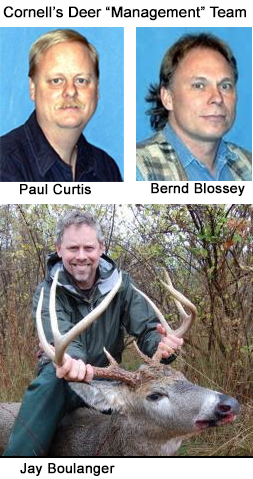
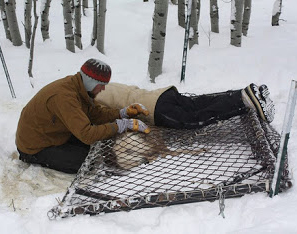 This photo is from Cranbrook, British Columbia, where a similar trap and bolt program has been carried out. After a captured deer has endured the frigid temperatures overnight, the killers arrive, the box trap is collapsed on top of the helpless and terrified animal, and a captive bolt gun is used to shoot a metal rod into her brain. Over the last couple weeks, a timeframe in which we know this kind of activity has been taking place here in Ithaca, the temperatures have plunged into the single digits on several occasions. This means captured deer could have spent hours exposed to the freezing cold, unable to seek the warmth of shelter before being slaughtered.
 That these abhorrent acts are being performed just out of sight under a facade of academic legitimacy makes the situation all the more disturbing. For many long-term residents, this is a troubling reminder of how the prestige and power of Cornell can be used as a cover to carry out actions that are so clearly harmful to the local community. In this case, the DEC’s political agenda -- which includes attempts to block NY State municipalities from taking a “no-kill” approach to addressing deer-human conflicts -- is being served without the community being adequately informed, much less given the opportunity to consent.
 We learned some shocking news today that has implications not only for the situation in Cayuga Heights, but for all of New York State.
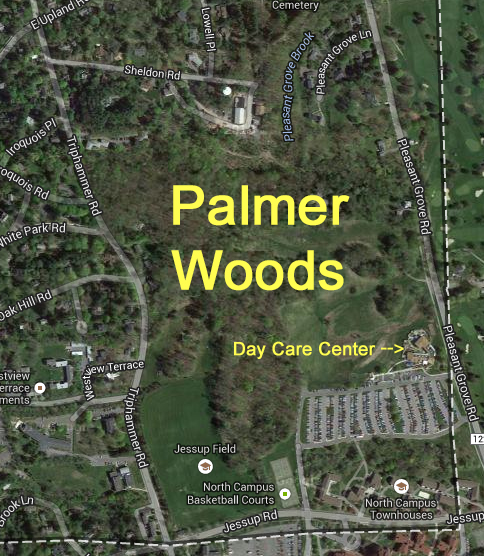 Ground Zero for Cayuga Heights' expected commencement of deer killing appears by all accounts to be Palmer Woods. This patch of land between Triphammer and Pleasant Grove Roads, just beyond the A Lot as you are heading away from Cornell, is a very active area. There is a day care center on the edge of the woods. There is a frisbee golf course in Palmer Woods. People walk their dogs in that area, and pedestrians cut through it on their way to campus. There is a parking lot with hundreds of cars on the edge of it, housing for hundreds if not thousands of students nearby, and it is bounded on two sides by two roads that are very well-traveled at all times of the day by people going into and out of Cornell's campus.



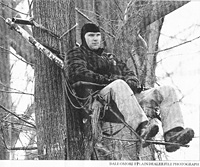


 Wednesday’s forum, while stacked with Mayor Supron’s “yes-men”, provides a rare opportunity to ask questions of the people who have collectively enabled the Supron administration’s divisive and dangerous agenda. There are also people on the panel who are in a position to financially benefit from the deer-killing program, or who have already benefitted from the drawn-out process that has required costly legal advice and hand-holding. While the situation will be tightly controlled – with questions only allowed to be asked in written form and then filtered through an intermediary of Mayor Supron’s choosing – we encourage you to attend, to ask the hard questions that need to be asked, and to bear witness to the quality of answers that are provided.



 In a major victory for those opposed to the Cayuga Heights “bait and shoot” deer killing program, Judges of the New York State Supreme Court Appellate Division have unanimously ruled in favor of a motion for Preliminary Injunction pending appeal of the lawsuit brought by 12 Ithaca area residents. This

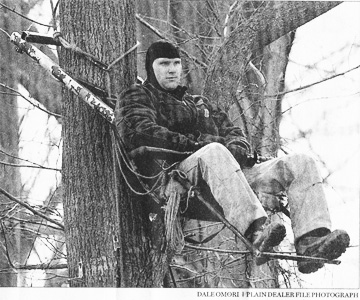
 Heights Residents File Complaint
 In granting this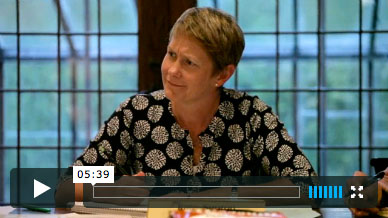
 So, in order to achieve their goal of killing all but 20 of the deer in the Village, the trustees will need to convince a large number of residents to sign off on the discharge of deadly weapons within 500 feet of their homes, weapons whose range goes far beyond 500 feet and are just as capable of killing a human, a dog or a cat as a deer.
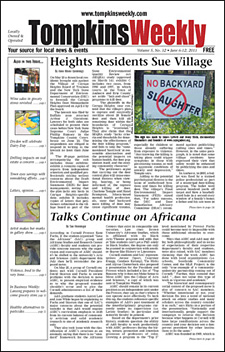

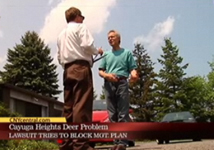




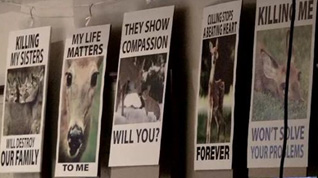


 On Friday, April 22 at 7 PM EST, CNN’s Headline News channel (HLN) will be airing another story about the Cayuga Heights deer controversy.

 At last week’s candidates’ forum in Cayuga Heights, the three trustees who will be running unopposed for re-election on Tuesday the 15th -- Bea Szekley, Robert Andolina and Stephen Hamilton -- each made statements indicating their embrace of a killing program based on the heinous
  So that the notion that it is somehow terribly cruel and unusual isn’t the truth.” Compare this statement, made by a professor of Human Ecology who appears to have done little research into the topic of Net & Bolt, with that of a former game council member for the state of New Jersey, who has firsthand knowledge. Jack Schrier

 Village employee resigns, speaks out






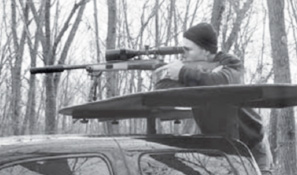 Regarding the killing of deer, White Buffalo’s Anthony DeNicola (pictured at right) is quoted in a 12/19/05 USA TODAY article as saying, “I do this every day. For me it’s like brushing my teeth.” A 1/23/05 article in THE GREENWICH TIMES reported: "’Once officials decide to reduce the deer population, they must be prepared to continue in subsequent years,’ said biologists and officials involved in deer reduction efforts. Many of them compare the efforts to manage the deer population to the concept of mowing the lawn. ‘Once you mow it, you're always going to be mowing it," said Anthony DeNicola, of White Buffalo Inc.’”
  Cornell’s Prof. Paul Curtis is the individual responsible for giving the trustees the scientific justification for their brutal plan. He also co-authored with White Buffalo’s Anthony DeNicola a 2000 publication titled “Managing white-tailed deer in suburban environments: a Technical Guide”. It was Curtis who originally proposed the idea that if the trustees marked and sterilized a small percentage of the deer and then killed the rest, perhaps these remaining deer would act as "placeholders" who, in some manner never convincingly explained, would repel neighboring deer from immigrating into the village due to the sudden decrease in competition for resources. At a July, 2009, videotaped public meeting, Curtis offered his “placeholder” theory:
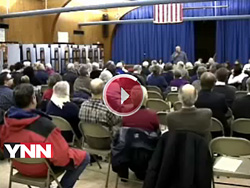
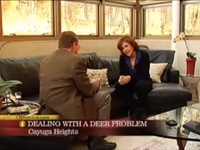


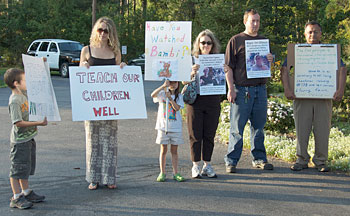


 The fair-minded journalistic effort that went into researching the actual role the deer play in the spread of lyme disease, how the reporting of cases in our community has changed in recent years, and what the experts feel is the best approach to preventing it, was refreshing. It was therefore all the more disappointing when the article went on to present the one-sided argument that deer are more of a threat to biodiversity in New York State than global warming!